Phygital, everyone has it. Phygital retail that sells, almost nobody does.
Everyone talks about phygital. Nobody explains why your store still isn’t converting.
There’s a word that by 2026 no longer means anything.
That word is phygital.
Not because the concept is bad. But because over the last three years it’s been used by so many people, so carelessly and with so little judgment, that you can no longer tell whether someone is talking about a business strategy or about the fact that they put an iPad on the counter and called a journalist.
Phygital is what the Barcelona agency designing industrial wearables for Taurus calls it. Phygital is what the Madrid consultancy doing UX for airport kiosk apps calls it. Phygital is what the startup that installed touchscreens in the fitting rooms of a chain losing two hundred stores a year calls it. Phygital is what the freelancer who built a landing page for a local fashion store and added an Instagram carousel to the window calls it.
And now you say phygital too, because if you don’t, it looks like you’re behind the times.
Welcome to the most inflated, most misused and most empty term in contemporary retail.
There are two kinds of phygital. And they have nothing to do with each other.
The first is technological phygital.
It’s the one designed by digital product agencies, UX studios, innovation consultancies and IoT labs. Their work is legitimate and, within its own territory, good. They connect physical devices to digital platforms. They design a medical wearable’s interface. They build the interaction system for a connected screen on a factory floor. They develop the app that pairs with a premium appliance.
All correct. All necessary. All completely disconnected from what happens inside a fashion store, a luxury boutique, a cosmetics flagship or a retail chain that wants its hundred square metres to stop being a cost and start being a machine.
The second is real retail phygital.
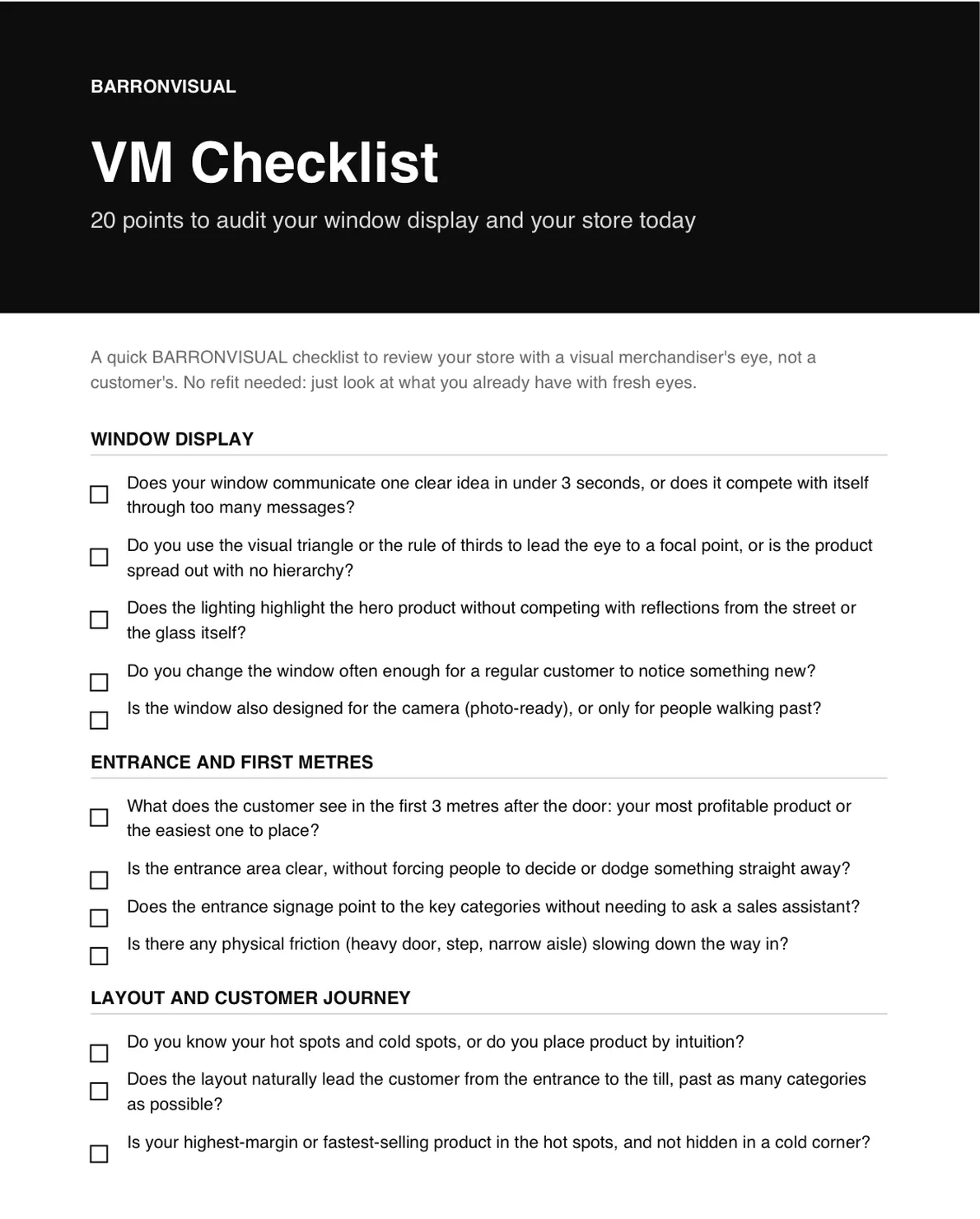
And that’s the one almost nobody knows how to do, because doing it requires having actually been inside. Not in a meeting room with a journey map on the wall. Inside. With the product in hand. With the badly lit mannequin nobody’s moved in three weeks. With the window display that’s had the same setup since the autumn campaign. With the entrance that stops the customer instead of inviting them forward. With the store team that doesn’t understand what the space they work in every day is supposed to communicate.
That’s the phygital that matters if you have a retail business.
And that’s exactly BARRONVISUAL’s territory.
Think in systems, not screens
There’s a phrase that circulates a lot in the world of phygital experience design: «think in systems, not screens».
It’s a correct phrase. The problem is that whoever usually says it is thinking of an IoT device’s data system or a multiplatform app’s architecture.
We say it thinking of something else.
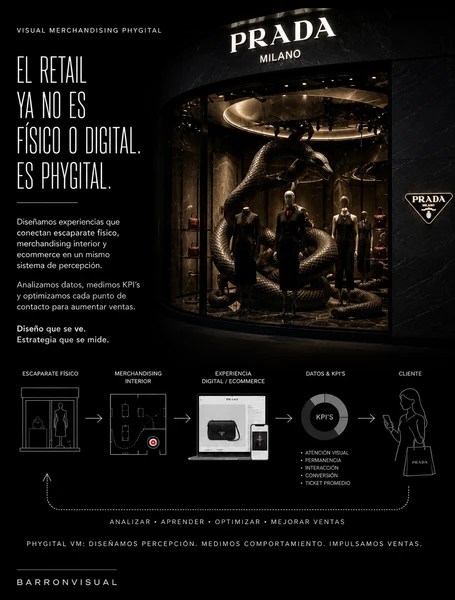
We think of the system that connects the window display to the entrance. The entrance to the journey. The journey to the product in hand. The product in hand to the purchase decision. The purchase decision to the average ticket. The average ticket to visit frequency. Visit frequency to brand perception. Brand perception to the content the customer shares before walking out the door.
That’s a system.
It doesn’t necessarily have screens. It can have them, if they serve something specific and measurable. But it doesn’t need them to be phygital.
What it needs is judgment. Logic. Direction. And someone who understands that every square metre of a store is a strategic decision, not a decorative one.