BARRONVISUAL
Blog·Phygital Merchandising

Phygital, Everyone Has It. Phygital Retail That Sells, Almost Nobody Does.

Juan Carlos Barrón·September 2026·Phygital Merchandising
Retail phygital que conecta la tienda física con lo digital

Phygital, everyone has it. Phygital retail that sells, almost nobody does.

Everyone talks about phygital. Nobody explains why your store still isn’t converting.

There’s a word that by 2026 no longer means anything.

That word is phygital.

Not because the concept is bad. But because over the last three years it’s been used by so many people, so carelessly and with so little judgment, that you can no longer tell whether someone is talking about a business strategy or about the fact that they put an iPad on the counter and called a journalist.

Phygital is what the Barcelona agency designing industrial wearables for Taurus calls it. Phygital is what the Madrid consultancy doing UX for airport kiosk apps calls it. Phygital is what the startup that installed touchscreens in the fitting rooms of a chain losing two hundred stores a year calls it. Phygital is what the freelancer who built a landing page for a local fashion store and added an Instagram carousel to the window calls it.

And now you say phygital too, because if you don’t, it looks like you’re behind the times.

Welcome to the most inflated, most misused and most empty term in contemporary retail.

Back courtyard of the Mango store on Calle Serrano in Madrid with mannequins in rusted-metal niches
Wonderful back courtyard of the Mango store on Calle Serrano, Madrid.

There are two kinds of phygital. And they have nothing to do with each other.

The first is technological phygital.

It’s the one designed by digital product agencies, UX studios, innovation consultancies and IoT labs. Their work is legitimate and, within its own territory, good. They connect physical devices to digital platforms. They design a medical wearable’s interface. They build the interaction system for a connected screen on a factory floor. They develop the app that pairs with a premium appliance.

All correct. All necessary. All completely disconnected from what happens inside a fashion store, a luxury boutique, a cosmetics flagship or a retail chain that wants its hundred square metres to stop being a cost and start being a machine.

The second is real retail phygital.

And that’s the one almost nobody knows how to do, because doing it requires having actually been inside. Not in a meeting room with a journey map on the wall. Inside. With the product in hand. With the badly lit mannequin nobody’s moved in three weeks. With the window display that’s had the same setup since the autumn campaign. With the entrance that stops the customer instead of inviting them forward. With the store team that doesn’t understand what the space they work in every day is supposed to communicate.

That’s the phygital that matters if you have a retail business.

And that’s exactly BARRONVISUAL’s territory.

Think in systems, not screens

There’s a phrase that circulates a lot in the world of phygital experience design: «think in systems, not screens».

It’s a correct phrase. The problem is that whoever usually says it is thinking of an IoT device’s data system or a multiplatform app’s architecture.

We say it thinking of something else.

We think of the system that connects the window display to the entrance. The entrance to the journey. The journey to the product in hand. The product in hand to the purchase decision. The purchase decision to the average ticket. The average ticket to visit frequency. Visit frequency to brand perception. Brand perception to the content the customer shares before walking out the door.

That’s a system.

It doesn’t necessarily have screens. It can have them, if they serve something specific and measurable. But it doesn’t need them to be phygital.

What it needs is judgment. Logic. Direction. And someone who understands that every square metre of a store is a strategic decision, not a decorative one.
If you want to master itVisual Merchandising Omnicanal · 299 €

Phygital that doesn’t convert is expensive set design

Here’s the diagnosis nobody wants to hear:

Most stores calling themselves phygital have added digital layers on top of a physical space that already wasn’t working. They’ve put technology on top of a problem that wasn’t technological. They’ve installed screens where the problem was product hierarchy. They’ve added QR codes where the problem was signage. They’ve thrown in immersive experiences where the problem was that the customer didn’t understand what the brand sold.

And the result is the same as always: more investment, same conversion.

Because phygital without a system isn’t a strategy. It’s an art installation with a card reader.

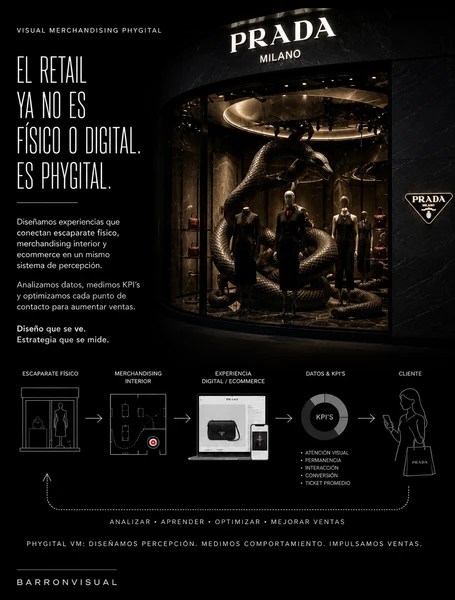
A Dior window display isn’t phygital because it has technology. It’s phygital because the image it builds on the street carries straight through into the entrance, the journey, the central table, the salesperson’s conversation, the bag the customer walks out with, and the content that shows up in their feed that same afternoon. All of that is a system. A system of perception, desire and conversion operating simultaneously in the physical space and the digital one.

That’s what we build at BARRONVISUAL.

Not technology on top of a broken space. A system that turns the space into performance.

BARRONVISUAL infographic on phygital retail with the Prada Milano window display

Why almost nobody can do this well

Because it requires two kinds of knowledge that rarely coexist in the same person or the same team.

Knowledge of the real physical space

Not the render. Not the floor plan. The space with customers inside it. With uneven traffic. With light that shifts at four in the afternoon. With a product that runs out on Tuesday and doesn’t arrive again until Friday. With a team that dismantles the window carefully, or does it in ten minutes, depending on the day.

That knowledge is only gained by being inside, for years, in demanding environments.

The digital system as an amplifier of the physical space

Not as a substitute. Understanding how the content a store generates feeds its digital presence. How a well-built window becomes Instagram material before anyone plans it. How a well-designed journey produces behavioural data that improves the website. How the in-person experience builds the trust that converts on eCommerce.

Without both, you have half.

With only the first, you have a classic visual merchandiser. Good in store, without a system. With only the second, you have a digital agency that’s never built a window display and calls sticking a QR code on the glass phygital.

With both, you have BARRONVISUAL.

What separates phygital that sells from phygital that impresses

Phygital that impresses generates conversation. Phygital that sells generates conversion.

The two can coexist. But when a brand prioritises the first while forgetting the second, it’s buying audience, not business.

Phygital that sells answers specific questions

  • What percentage of the traffic that comes in converts?
  • What visual element stops the customer at the entrance?
  • Where does the journey get abandoned?
  • Which product is never touched, and why?
  • What does the window display actually communicate versus what the brand thinks it communicates?
  • How is the physical space’s impact on online sales in the same geographic area measured?

A touchscreen doesn’t answer those questions. A system does.

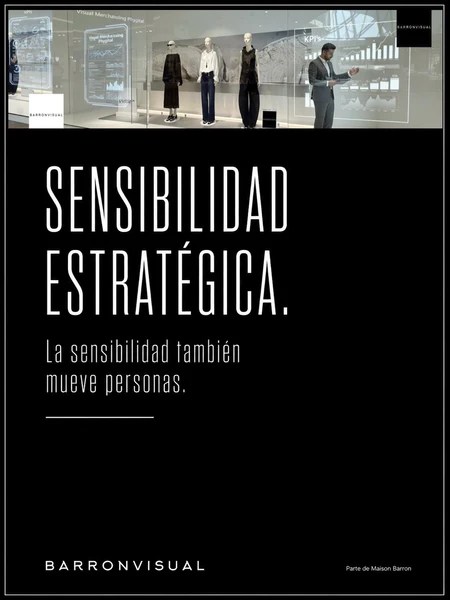
BARRONVISUAL infographic on strategic sensibility in phygital visual merchandising

At BARRONVISUAL we don’t design phygital so it photographs well

We design phygital systems so a store converts better tomorrow than it does today.

Because real phygital isn’t seen. It’s measured.


I’m Juan Carlos Barron, visual merchandiser, window dresser and digital craftsman with 30 years of experience and strategic sensibility.

BARRONVISUAL is part of Maison BARRON.

Free resource

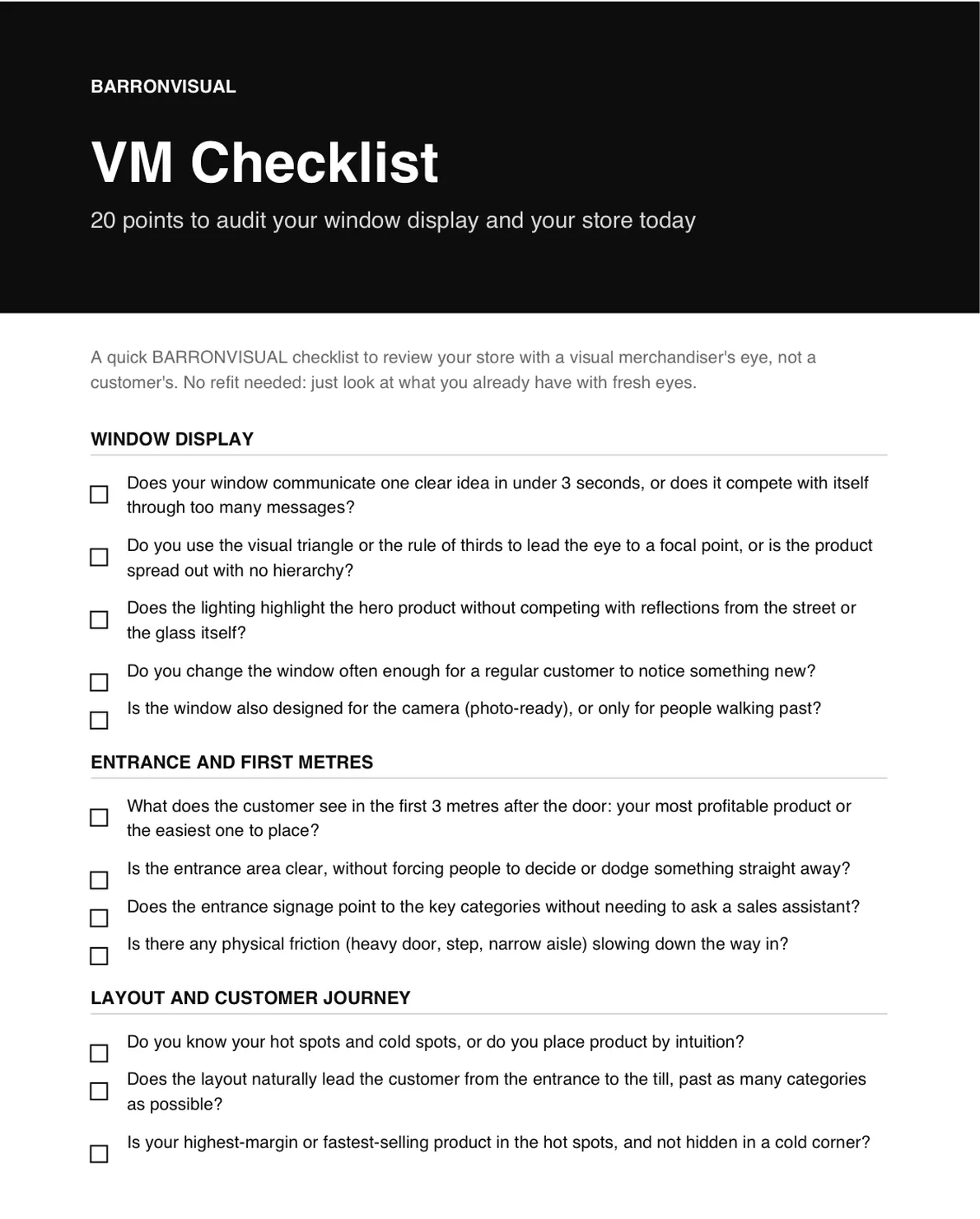
Cover of the BARRONVISUAL VM Checklist PDF

VM Checklist: 20 points to audit your storefront and your store today.

A short PDF to review your store with a visual merchandiser's eye, not a customer's. No renovation needed, just look at what you already have with fresh eyes.

Who are you?

I send you the PDF and, over the following days, 4 short emails to apply it. Unsubscribe in one click.