BARRONVISUAL
Blog·Opinion

How Much Is a Window Dresser or Visual Merchandiser Worth? In Spain, Barely Above Minimum Wage

Juan Carlos Barrón·September 2026·Opinion
Escaparate de CHANEL con figuras recortadas en blanco y negro en poses dinámicas, diseño de Juan Carlos Barrón

I’m going to say something that many retail offices in Spain don’t say out loud: visual merchandising gets paid like it’s decoration. And window dressing, like a favour. This morning, coffee in hand, I opened LinkedIn, typed «visual merchandising» and read slowly. I recommend the exercise. It hurts, but it clarifies things.

Louis Vuitton is looking for a Visual Merchandising Manager for the Mediterranean region based in Madrid. Loewe, a specialist for southern Europe. Estée Lauder, Percassi for Victoria’s Secret, AWWG for Hackett. And Mango, a visual merchandiser for Parquesur. Thirty-five hours a week.

I switched tabs. London: Adidas wants a «Flagship Visual Merchandiser Expert» for Oxford Street, H&M is hiring people in Bristol, & Other Stories in Oxford and Hackett again, this time in London and tagged URGENT. Paris: C&A is hiring Visual Merchandiser Managers on permanent contracts, Mango the same on the outskirts, Moncler a visual for its flagship.

Same brands. Same trade. Sometimes, the same corporate group. The difference isn’t in the job listing. It’s in the payslip. And what that payslip says about how Spain understands store design is, to put it generously, worrying.

Louis Vuitton facade in Paris with the giant figure of Yayoi Kusama
Louis Vuitton × Yayoi Kusama, Paris. This is how a window display is treated when it’s understood as an investment.

A visual merchandiser’s salary in Spain: the numbers without makeup

Spain: between €7,000 and €9,500 above minimum wage

According to Indeed, the average salary in visual merchandising in Spain is around €26,500 gross a year, with a typical range of €20,800 to €33,700. Glassdoor is even less generous: around €24,150 on average. The 2026 minimum interprofessional wage stands at €1,221 across fourteen payments, that is, €17,094 a year.

Do the maths. The person who decides how the customer enters your store, what they see first, where they stop and what they end up taking to the till earns, on average, between €7,000 and €9,500 a year above the legal minimum. Less than what many brands spend putting together a single Christmas window display.

Paris, London and New York play in a different league

In Paris, Glassdoor puts a Visual Merchandising Manager at a median of €54,300, with a range of €43,000 to €63,000; at houses like Dior or LVMH, medians run between €52,000 and €60,000. In the UK, Indeed shows £26,573 as the national average, £28,397 in London and around £42,600 for senior profiles. In the United States, the average visual merchandiser earns around $55,000 and seniors are around $86,600, with ceilings reaching $120,000.

At the approximate exchange rate, a senior in the United States is around €74,000. In London, close to €49,000. And in Spain? Glassdoor puts seniors between €32,000 and €52,000. And mind you, €52,000 is the ceiling, not the average. I know very few people who reach it.

Hermès window display
Hermès. In France, window dressing is a trade with a career ladder, not a favour you ask the store manager for.

«Sure, but life is more expensive there»: the objection that doesn’t hold up

At entry level, the difference is reasonable

I knew you were going to say it. And you’re partly right: with £28,000 in London you cover rent, a tube pass and little else. At the first rung, the gap with Spain isn’t scandalous.

The scandal is in the ladder

In France and the United States this trade has a career with a top floor: visual, senior, manager, regional, director. Every rung is paid for. In Spain the ladder ends at the second rung, and «senior» usually means the same salary with more stores under your charge and more kilometres on the road. It’s not the cost of living. It’s the value placed on the role.

If you want to master itWindow Display Killer · 149 €

Window dressing and store design in Spain: why they get paid like decoration

The payslip is an opinion

A payslip is the most honest way a company has of telling you what it thinks of your work. And in much of Spanish retail, what it thinks is this: the visual merchandiser is «the one who dresses the mannequins». Decoration. A cost. Someone who reports to the store manager and is asked to «make it look nice» for Saturday.

In France, the visuel merchandiser is a métier, with schools, permanent contracts and status. The Christmas window display of a Parisian department store is a cultural event that opens the evening news. In London, Oxford Street window displays are designed a year in advance and with advertising campaign budgets. Anyone who has worked on both sides of the Pyrenees knows it: over there, they ask you what you need. Here, too often, how much it’s going to cost.

The country that invented the idea that the store is the advert

The most absurd part is that Spain is the birthplace of the model. The country where the idea was born that the store is the advert, that you barely need advertising if the window display and the customer journey do their job, is the same one that pays the people who build that journey as if they were seasonal sale staff. We export the method and keep the salary.

Interior of Zara’s flagship store in Shanghai
Zara, Shanghai flagship. The Spanish model of «the store is the advert», exported to the world.

The pay transparency directive is about to spoil the party

There’s a detail keeping more than one HR department up at night. The European Pay Transparency Directive requires candidates to be informed of the starting salary or salary range before the interview, usually in the job listing itself. The deadline for transposing it into national law ended on 7 June 2026.

I’m curious to see how many job listings keep asking for «passion for fashion, mastery of Adobe, fluent English, a driving licence and availability to travel» once they have to put the figure next to it. It’s going to be a very healthy exercise in collective humility.

The uncomfortable part: we visual merchandisers are partly to blame too

Without store KPIs, you’re decoration

It would be very easy to put all the blame on the employer. But visual merchandisers have our own share of it too. For years we’ve sold ourselves as artists rather than what we are: people who move numbers. If you can’t prove that your window display has raised footfall, that your store layout has improved conversion rate or units per transaction, that your new-arrivals table sells more per square metre, they’re going to pay you like decoration. Because that’s the only thing you’ve shown.

Phygital retail: the way out almost nobody is taking

There’s another irony. Today the same logic we apply in store applies on screen: a website’s homepage is a window display, the product page is a table, the checkout is the till. Brands pay a digital experience designer, without blinking, what they deny someone who has spent twenty years doing exactly that in real square metres. The visual merchandiser who understands both worlds, physical and digital, and can speak the language of KPIs, will never have to negotiate their salary from a position of weakness again.

So no, the problem isn’t that there’s «no money» in Spain. There’s money to rent premises on Gran Vía, for store refurbishments every three years and for influencer campaigns. What’s missing is understanding that the window display isn’t an expense: it’s the first sale of the day.

Mango store on Calle Serrano in Madrid
Mango, Serrano (Madrid). Prime location, flawless refurbishment. And the salary of the person who makes it sell?

Stop treating your window display as an expense

If you have a store or a brand, try it: measure your footfall rate before and after a window display change. If you don’t know how to measure it, that’s your first problem right there. At the BARRONVISUAL Estudio we design window displays, visual merchandising and store design with measurable goals, and at Consultoría we help you build the team and the KPIs so that visual merchandising stops being a cost and starts being a sales lever.

If you’re a visual merchandiser or window dresser and you’re tired of negotiating from a position of weakness, learn to speak the language companies pay for: data, conversion, physical and digital customer experience. That’s what the BARRONVISUAL Academia is for.

And now, your turn. How much do you earn? Have you ever been offered a visual merchandising position in Spain with the salary written in the listing? I’ll be reading the comments. And if you’re a business owner and this article rubbed you the wrong way, even better: write to me too. That was the point.

Frequently asked questions

How much does a visual merchandiser earn in Spain?

According to Indeed, the average is around €26,500 gross a year, with a typical range of €20,800 to €33,700. Senior profiles fall between €32,000 and €52,000 according to Glassdoor.

Which country pays the best for visual merchandising?

Among those compared, the United States and France. A senior in the US is around $86,600 and a Visual Merchandising Manager in Paris has a median of €54,300.

What does a visual merchandiser do and why does it influence sales?

They design how the product is presented in window displays, tables and shelving, and how the customer moves through the store. Footfall, conversion and units per transaction all depend on their work.

How can a window dresser raise their salary?

By proving results with data and expanding their profile into the digital environment. Anyone who masters store KPIs and online visual merchandising negotiates from a different position.

Will it become mandatory to publish salaries in job listings?

Directive (EU) 2023/970 requires candidates to be informed of the starting salary or salary range before the interview. The deadline for transposing it into national law ended on 7 June 2026.


Sources (consulted in September 2026): Indeed Spain · Glassdoor Spain · Glassdoor Paris · Indeed UK · Glassdoor US · Glassdoor US (senior) · SMI 2026 · Directive (EU) 2023/970. Approximate currency conversions.

Free resource

Cover of the BARRONVISUAL VM Checklist PDF

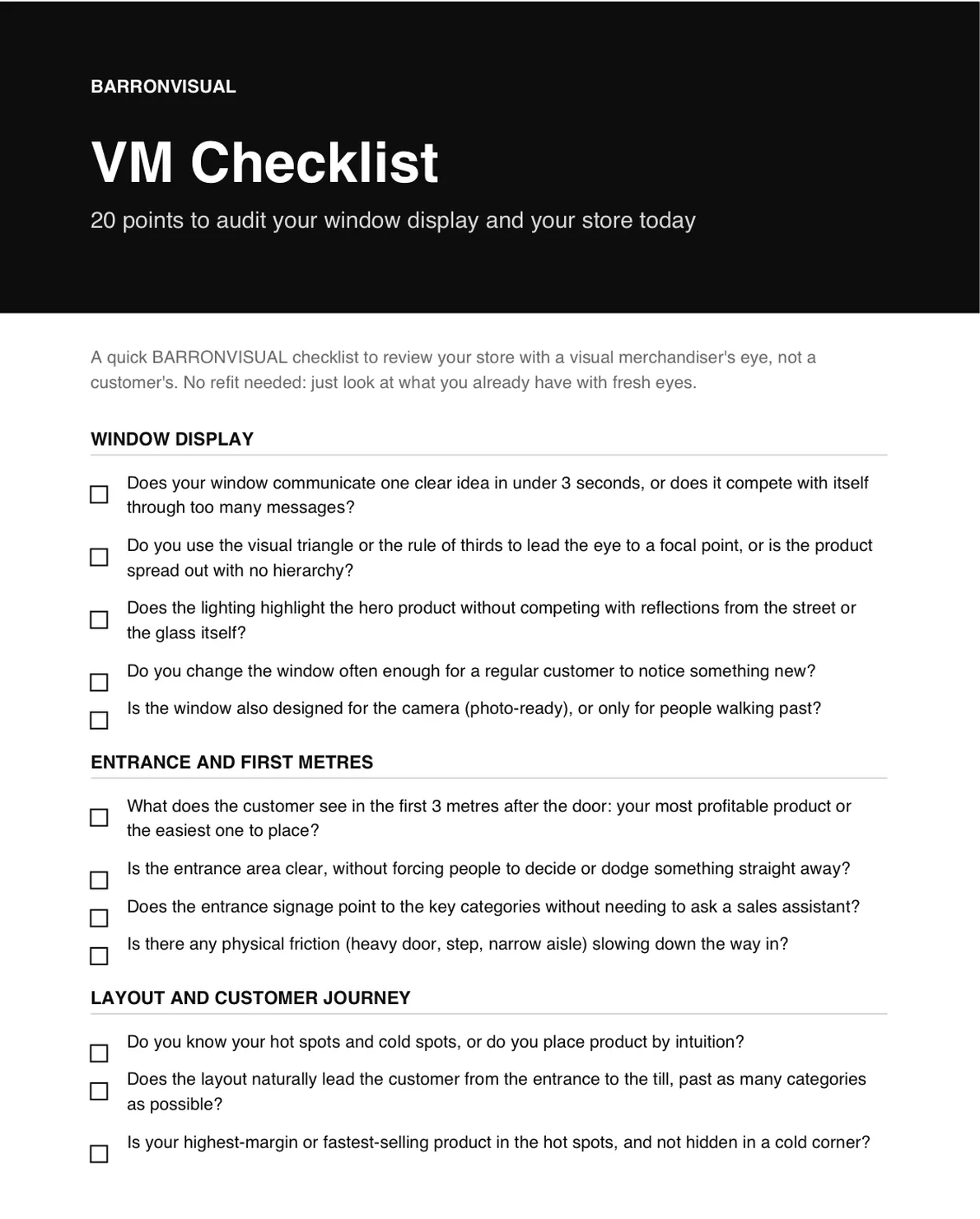
VM Checklist: 20 points to audit your storefront and your store today.

A short PDF to review your store with a visual merchandiser's eye, not a customer's. No renovation needed, just look at what you already have with fresh eyes.

Who are you?

I send you the PDF and, over the following days, 4 short emails to apply it. Unsubscribe in one click.