BARRONVISUAL
Blog·Phygital Merchandising

AI in visual merchandising: what works and what is hype

Juan Carlos Barrón·November 2026·Phygital Merchandising
Gemelo digital de una tienda Lowe's creado con NVIDIA Omniverse

Every week a new tool lands in my inbox promising to revolutionise the store with artificial intelligence. Some are useful. Many are a marketing layer over something that already existed. And quite a few are pure hype with a logo. After more than 25 years arranging stores, my rule for AI in visual merchandising is simple: it’s worth it when it helps decide better which product goes where and when, and when that decision can be measured. If it only produces pretty images, it’s decoration. Expensive decoration.

Here are real cases from brands already using it, a table separating what works from what doesn’t, the questions to ask before paying a vendor, and how to start without burning money, whether you have one store or two hundred.

Infographic comparing what works and what is hype in AI for visual merchandising: data, space, shelf, window, screens and team
Six areas, one question: which decision does it improve, and how is it measured? Infographic: BARRONVISUAL.

What works: real cases, not promises

Real-time product data: Zara and RFID

Inditex has been tagging its garments with RFID for years: each one has a unique identifier that shows in real time what is in every store and online. In March 2025 it announced a further step, piloted in four Zara stores (Compostela in A Coruña, Gran Vía in Bilbao, Plaza de España in Madrid and Paseo de Gracia in Barcelona): staff read the garments with a handheld device, deactivate the security tag and take payment anywhere in the store, without going to the till.

That isn’t AI in itself. But it’s the foundation for everything else: without reliable stock and sales data per item and per zone, no algorithm decides well. If your store doesn’t know what sells on the entrance table versus at the back, the first step isn’t AI. It’s measuring.

Zara staff member reading the RFID tag of a sweater with a handheld device to take payment away from the till
Zara: RFID reading and payment anywhere in the store. Useful technology gives you data and frees the team to serve. Photo: Inditex / Europa Press

Simulating before moving fixtures: Lowe’s digital twin

Lowe’s, the US home improvement chain with more than 2,000 stores, presented digital twins of two stores (Mill Creek, Washington, and Charlotte, North Carolina) in 2022 with NVIDIA Omniverse and Magic Leap. With them, associates use AR headsets to compare how a shelf should look with how it actually looks, leave notes for central planners about planogram improvements, and see 3D heatmaps of items bought together but placed far apart. Above all, they simulate different layouts with historical order data before moving a single fixture.

For a chain, this saves installs that don’t work. For a small store, the affordable version is a floor plan, before-and-after photos of every change and the sales next to them. The logic is the same: test on a copy, not on the customer.

Lowe's store aisle shifting from the real photo to the white digital twin built with NVIDIA Omniverse
Lowe’s: the real aisle on the left and its digital twin on the right. Test the layout on the copy before touching the store. Photo: Lowe’s / NVIDIA

Computer vision on the shelf: the planogram that polices itself

In April 2026, US convenience chain QuikTrip and SymphonyAI won a Convenience Store News award for planogram excellence. Their system designs planograms by store cluster and uses computer vision to compare shelf photos with the approved planogram: it detects stock-outs, misplaced products and execution gaps. QuikTrip grew from around 700 to more than 1,200 stores while staying consistent. Note: they published no sales percentages, and that is information too.

What matters for visual merchandising isn’t the technology, it’s what it frees up: the team stops checking shelves by hand and spends its time fixing what actually fails. A performance planogram like the one below, with each item coloured by how it sells, is exactly the kind of data an algorithm can read and a good VM knows how to interpret.

Baby food category planogram with items coloured by performance
A performance planogram: each item coloured by how it sells. It’s the language both AI and the visual merchandiser understand. Planogram: Qmax Retail Solutions.

Help with repetitive tasks

Writing product copy, translating a visual merchandising guide into three languages, preparing sign variations, summarising weekly sales by zone or suggesting ten concept ideas for a sale window. Here AI saves real hours, as long as someone with judgement checks the result. It’s a very fast intern who doesn’t know your brand: useful if you correct it, dangerous if you leave it alone.

Analytics dashboard with an activity chart and a heatmap on a screen
Summaries, dashboards and patterns: here AI saves hours, if someone with judgement reads them. Photo: 1981 Digital / Unsplash

What is hype (for now)

The “AI-designed” window with nobody behind it

Generated images are a starting point, not a buildable project. They have no measurements, materials, weight, real light or your real product. Nobody can fabricate a backdrop from an impossible render. They’re good for opening ideas in a meeting; the window is still designed by someone who knows how to hang a mannequin.

Screens with automatic content nobody watches

A screen isn’t phygital by itself. If it isn’t connected to the product and the customer journey, it’s expensive noise. The two photos below explain it: in the first, the screens are the whole window and become a sculpture; in the second, the screen shows the detail of the product in front of you. Both have an idea behind them. An auto-generated looping video doesn’t.

Zara facade with a window made of video screens stacked into a column
Zara: screens stacked like a video sculpture. Technology serving a window idea, not the other way round. Photo: Juan Carlos Barrón
Printemps window in Paris with a mannequin, campaign photo and a screen showing the garment detail
Printemps, Paris: the screen shows a close-up of the mannequin’s garment. Connected to the product, the screen sells. Photo: Juan Carlos Barrón

Promises of “+X% sales” with no comparable case

When a vendor promises a percentage, ask for three things: the exact figure, the period and what it’s compared with. Same store, same month last year, same range? No answer, no case. Notice that even the award-winning cases above talk about availability, consistency and time saved, not magic sales figures.

If you want to master itVisual Merchandising Omnicanal · 299 € →

Before buying AI: the pyramid

Three-level pyramid: data at the base, decisions in the middle and AI at the top
Data, decisions and AI, in that order. Without the base, the top floor collapses. Infographic: BARRONVISUAL.

Five questions before paying an AI vendor

  1. Which specific decision does it improve? “Optimising the experience” isn’t a decision. “What goes on the entrance table every Monday” is.
  2. What data does it need, and do I have it? If the answer is “everything”, start by having it.
  3. How is the result measured, and against what? Comparable period, store and metric.
  4. Who checks what it suggests? Always a person with brand and product judgement.
  5. What happens if I switch it off? If your store stops working, you didn’t buy a tool: you bought a dependency.

How to start without burning money

  1. Measure the basics every week: footfall, conversion, average basket and sales by zone.
  2. Use AI for repetitive work (copy, translations, summaries) and keep the judgement for yourself.
  3. Test one change at a time and compare with the previous period.
  4. Invest in technology only when you know which decision it will improve and how you’ll measure it.

“If I don’t jump in now, I’ll be left behind”

It’s the line that sells the most software. And it’s half true. You fall behind if you don’t measure, if you lack judgement and if you don’t know what each metre of your store sells. You don’t fall behind for not having an AI screen in the window. The brands using AI well today have spent years organising their data. Start there and you’ll be ahead of most.

Even Amazon has put it in writing. On 27 October 2026 it published a guideline for its engineers acknowledging that measuring work by AI usage (tokens consumed, tools adopted, code changes) is “deeply flawed”, because it is disconnected from what matters. And it adds: “If your work does not benefit from current AI tooling, that is a finding, not a failing.” The same goes for a store: what counts is sales, conversion and the time you free up for your team, not how many tools you have.

Self-criticism: visual merchandisers sell hype too

Not all the hype comes from tech companies. Industry professionals have also started putting “AI” in every proposal because it sells, even when there’s just a moodboard generated in ten minutes behind it. At the same time, many of us refuse to learn to read data because “our job is creative”. Both hurt us. The visual merchandiser who understands data and uses AI with judgement will be more valuable than ever. The one who only generates images won’t be needed.

Your next step

Technology changes fast; the customer journey, much less. That’s why the foundation stays the same: good, measured visual merchandising, in store and online. I develop it in the Omnichannel Visual Merchandising master class and in Retail Performance Intensive, and apply it in store with the Phygital Retail Audit. Which AI tool did someone try to sell you this year? Tell me in the comments.

Frequently asked questions

What is AI in visual merchandising?

It’s the use of algorithms, computer vision and generative models to help decide which product is displayed, where and when, and to check that the roll-out is executed in store.

Can AI design a store window?

It can suggest ideas and starting images. But a window needs real measurements, materials, light and product, and that takes a professional.

What is a store digital twin?

A virtual copy of the store, with its fixtures and products, used to simulate layout changes and see data about the space before touching the real store.

Where should a small store start?

By measuring footfall, conversion and sales by zone every week, and by using AI for repetitive tasks like copy and translations, always checked by a person.


Sources (accessed October 2026): Forbes España / Europa Press, Inditex’s new payment system (March 2025) · NVIDIA, Lowe’s store digital twins (2022) · Lowe’s press release · SymphonyAI and QuikTrip, planogram excellence award (April 2026).

Free resource

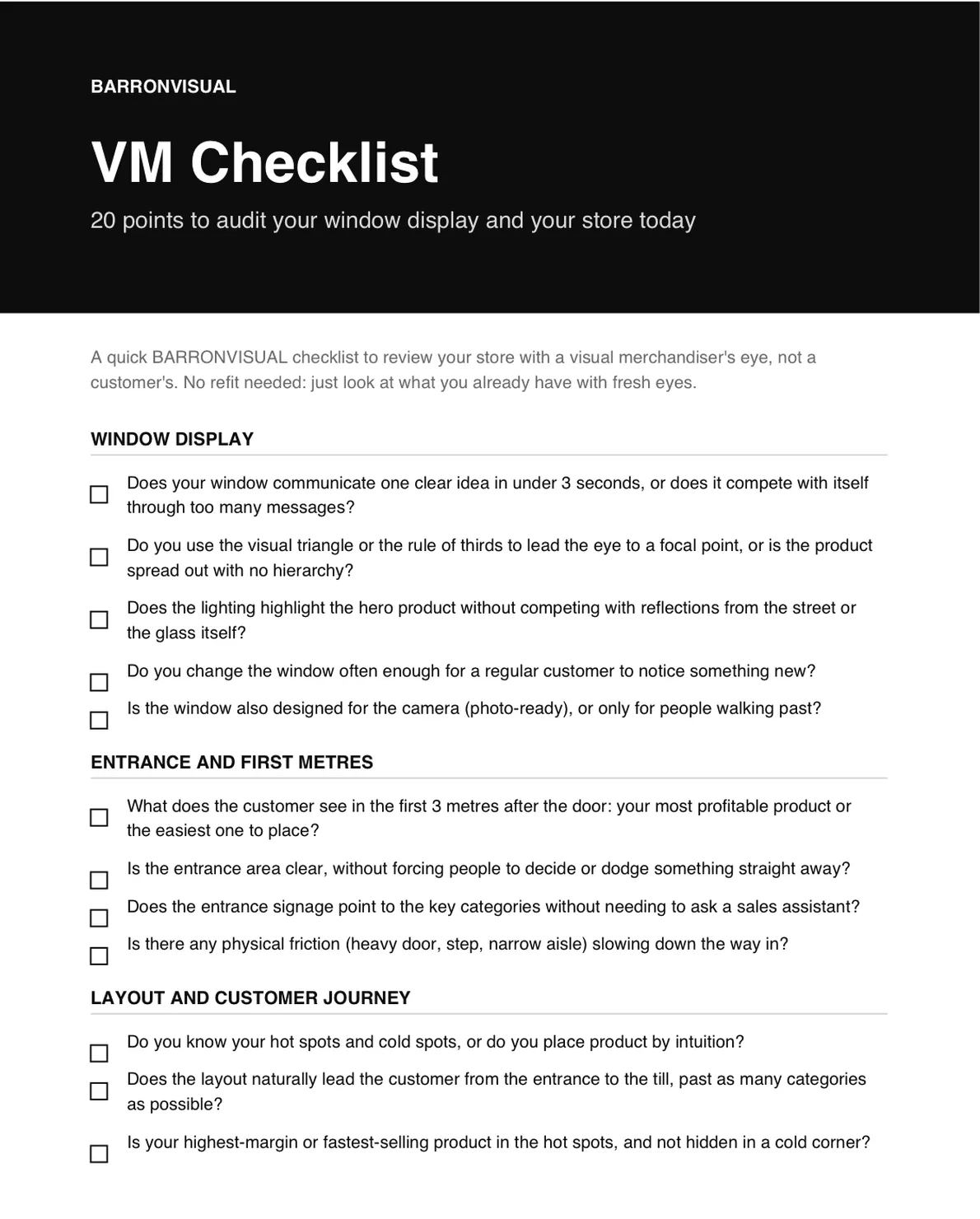
Cover of the BARRONVISUAL VM Checklist PDF

VM Checklist: 20 points to audit your storefront and your store today.

A short PDF to review your store with a visual merchandiser's eye, not a customer's. No renovation needed, just look at what you already have with fresh eyes.

Who are you?

I send you the PDF and, over the following days, 4 short emails to apply it. Unsubscribe in one click. We handle your email under our privacy policy.