BARRONVISUAL
Blog·Visual Merchandising

The Only 36 Things a Visual Merchandiser Must Know How to Do

Juan Carlos Barrón·September 2026·Visual Merchandising
Visual merchandiser trabajando en el diseño de un escaparate

The Visual Merchandiser profession has changed radically over the last few years. It’s no longer enough to know how to set up a pretty window display or place a product correctly. Today a Visual Merchandiser must master skills ranging from design and creativity to management, communication, marketing and technology.

This guide brings together the 36 skills I consider essential for building a solid career in Visual Merchandising. Some are technical, others strategic, and many are only learned through experience.

Whether you’re just starting out or already working in retail, this article can serve as a roadmap to becoming a much more well-rounded professional.


Professional development of the Visual Merchandiser

Write a good CV and join LinkedIn

An essential tool for a visual merchandiser to get a job is their CV. It works as an advertisement to get called in for the interview you want. When a «visual» professional doesn’t put together an attractive, impactful and effective résumé, how could they possibly land a visual merchandising job? On top of that, the go-to tool for finding work today is LinkedIn, so you need to be a master of that social network.

Answer well in a job interview

Often, applicants don’t know how to communicate their worth to the company they’re dealing with. You always walk out of the interview feeling like you only said half of what you meant. You don’t need to speak like a diplomat, but you should at least know how and what to answer, and above all, what NOT to answer… and that way secure the job. There are plenty of tutorials online for learning how to handle a job interview. And always carry your business card (if you’re freelance) and your portfolio of work or projects.

Develop a career plan

A career plan is a roadmap to success in this field. It will guide you toward becoming a better professional and help you make good decisions whenever things change. Write down your goals, with dates and the companies you’d like to work for based on your tastes and skills. Do your best to follow it. Reread it from time to time. And go for it.

Build a Portfolio of Work

This is a selection of your work, the best of it. The proof that you deserve to be hired for the job you want should be found in your portfolio. You can build a lot of credibility by showing the interviewer your previous projects, because through them they can gauge what you could do for them. And it should already be virtual, presented on websites dedicated to this, such as http://www.behance.net/barron

Use social media professionally

I’ve met many merchandisers online, and most of them don’t use social media professionally, with personality and seriousness (even if with a touch of warmth). They can do as they please, but if you want to be professional about your VM career, you need to harness the enormous power of the internet to open better opportunities for yourself. And you can be bold, even provocative, but always with personality and seriousness.


Organization and work management

Write Activity Reports

Generally, «merchandisers» aren’t required to submit activity or objective reports, but if you’re a good «visual» who doesn’t want to go unnoticed, you have to write the task-completion report, even if it isn’t required. No one will know what value you’ve brought to the company if you don’t communicate it. It’s essential. As a rule, setting aside Fridays for this kind of admin work is highly advisable.

Coach / Trainer

As a visual merchandiser, you’re expected to know visual merchandising techniques better and in more depth than anyone else. And it’s also an important part of our job to train salespeople or store staff on the basics, especially newcomers. The best way to teach is by example, practical example. Let them see how intensely you live merchandising and how important it is to you. It’s not only a way of sharing your knowledge and skills with your colleagues, but also of lightening your own workload, since many store staff carry out, and do very well, the most common tasks in our daily basic work. This also helps in selecting future «visuals» for our department.

Planning and Budgeting

If you don’t plan, you’ll most likely fail, and if you don’t budget, you’ll most likely go off track. Planning and budgeting are very important for every visual merchandiser carrying out any project. Even the most everyday tasks, when well planned, will make your work run smoothly.

Organization and Time Management

Wherever you’re working as a visual merchandiser, whether in a small neighborhood shop, a shopping mall, for a luxury company, for a furniture company, in winter or in summer, you need to organize yourself accordingly. Think carefully about who you work for, what time of year it is, what area you’re in, and so on. The way you organize things and manage your time always affects your performance. You have to choose between being organized or being defeated.

Use Google effectively

You already know the internet has every piece of information you can imagine, from the best things to the worst, and Google is the search engine most likely to give you the exact answer or photo you need. Don’t browse aimlessly or wander off… Look for pages that keep you updated on visual merchandising, such as https://www.facebook.com/J.CarlosBarron.G to waste as little time as possible.

Occupational Risk Prevention

Safety first, because a visual merchandiser who falls off a ladder and gets hurt definitely can’t finish their work. Not only that, some of the daily tasks carry considerably more risk than climbing a ladder, such as electrical setups. That’s why special care is needed. You work as a «visual» to earn a living, not to hurt yourself. You should ask your company for (or take on your own) an Occupational Risk Prevention course specific to commercial spaces.

Stay sharp. Do your research.

A trend is always just that: a trend, meaning it’s never static, it changes. A good visual merchandiser must know what’s «IN» and what’s «OUT» in order to better capture the attention of informed, modern customers. Doing research online, visiting art exhibitions, traveling to urban areas, reading fashion or decor magazines, or ones specialized in visual merchandising, will, without you even realizing it, let you build better strategies that keep adapting to shoppers’ new needs.

If you want to master itWindow Display Killer · 149 €

Essential digital tools

Know how to use a word processor

This might sound funny, but it’s true, not all window dressers or visuals know how to use word processing software. We’re in the digital era; typewriters belong in museums.

Spreadsheets

Tables and numbers are handled much better in a spreadsheet program (like Microsoft Excel or Apple Numbers). This tool is very effective and saves a lot of time when it comes to reports or budgets that need to crunch numbers. If you don’t know how, take a quick course right now. Don’t keep reading. Now.

Use PowerPoint

The best way to communicate with your boss or your team is to present your proposals and projects using PowerPoint or any other presentation software. You’re supposed to be a «Visual,» so you might want to know that visual aids greatly improve the chances of selling your idea. That’s why you need to know how to use a presentation program well. And the best one is Prezi: http://prezi.com/gn2lu6s04fsn/retailtainment/

Use graphic design software

Graphic design is now an essential part of visual merchandising. Signage, posters, window vinyls, slogans and other graphics matter a great deal for a better store image and for making it easier to find a product. In fact, many companies are hiring «merchandisers with graphic design skills,» who obviously carry out both visual merchandising and graphic design tasks. If you don’t know Photoshop, you’re nobody. And if possible, some grounding in Illustrator and InDesign.

Use a DSLR camera

You can take more creative photos with a DSLR (Digital Single Lens Reflex) camera than with a compact camera or your phone (this is something I should apply to myself too). In our field, knowledge and skill in product photography is extremely important, and DSLR cameras have advanced features that let you, once again, present your work in a better, more creative way.

Take good photos

Knowing how to use a digital SLR camera is no guarantee that you’ll take good photos. It’s not just important to be able to take good photos of your window displays or your store to add to your portfolio, but also because good photos are one of the basic building blocks of graphic design. You need to take photos of elements that can help sell the item.


Window display design and visual communication

Color Harmony

The worst «visuals» are the ones who don’t understand color harmony, or what’s called «color theory» here. You can’t be called a «visual merchandiser» if you drop the «visual,» or you’ll just be a shelf-stocker at your local supermarket. You need to know how to harmonize colors or how to contrast them. It’s proven that color draws a great deal of attention, but if used incorrectly, it can even hurt people’s eyes.

Drawing

Whether it’s to design or sketch a window display or to conceptualize a poster, you first need pencil and paper to draw your idea. Besides that, when computers and printers aren’t available, you might have to write your product’s prices by hand using markers or chalk on a blackboard. Drawing skills come in handy in those cases. Those of us who are bad at it have to rely on other people…

Set up a window display

Anything to argue about here? You can’t be a visual merchandiser if you don’t know how to design, produce and set up a window display. Window display is a minor, ephemeral art, but it is an art. And both selling and making people dream is our ultimate goal. So creating an effective window display to achieve that is your greatest task as a visual merchandiser.

Making «Props»

Don’t know this word? That’s not good. Get it into your head right now. A window display or good interior merchandising couldn’t be done without props, supports or adornments, because props beautify, decorate and add value to the product. Feathers, little birds, stars, flowers… Renting a support element every time you need one is very expensive and not advisable to do regularly. Paper products and recycled materials are the most cost-effective props being used today. You should know a bit about crafts and handiwork.

Dressing Mannequins

It’s very easy to dress a mannequin. Do you really think so? Do you know how to take the arms and legs off a mannequin and then put shirts and pants on it and put them back on again? To dress a mannequin you have to think like you would about a garment’s design, like a pattern with its pieces. And you also have to think like a fashion designer, because not every visual knows how to choose a good combination of merchandise to put on those particular mannequins. There are mannequins with very varied and complicated shapes and postures to dress.

Lighting

Most store windows have a fixed lighting system in place. Often scarce, ineffective and fixed, meaning it can’t be moved, but since the architects of the stores know everything and never consult VM professionals, we later have to try to fix this… Is the only thing you need to do point the beam of light at the product? False. It depends. You also need to know about direct and indirect lighting, about what you want to show or suggest, and about the quality of your product… A lot of direct lighting can reveal its poor quality… A short course, which your store’s or company’s light-fixture supplier will be happy to give you, can help you learn this.

Floristry, Hairdressing and Makeup

Flower arranging is the art of arranging flowers to be more pleasing to the eye and the emotions. Whether it’s a set of fresh, dried or artificial flowers, you need to know something about the subject to present them in the window display or in the store’s interior decor. Knowing something about this also comes in handy, although at the florist’s they’ll do it perfectly for you if you explain what you want.

The same goes for flower arranging: to style your mannequins’ wigs, if you don’t know how, take them to the hairdresser, but at least you should be able to explain what you want. And it always helps to know a bit about hairdressing… and makeup.

In-Store Visual Merchandising Techniques

Facing

You need to know how to fold t-shirts, even the worst-quality ones. And with ease. You need to face stacks of product well so they all look the same, regardless of size or design. You need to know how to group product at the top of shelving units (usually the ones that are hard to reach), and you need to know how to show the detail that makes that garment special, and display it in the fold. Time to practice!

Dressing a table

You need to know the techniques of the table runner and use them. Working in a home decor or homeware store can come in very handy. A well-edged, well-dressed table greatly increases the appeal of the products displayed on it.

Virtual Merchandising

What is this, you ask? Well, it’s a concept I made up myself. It’s visual merchandising applied to e-commerce. Some call it web styling or web merchandising. It’s about creating product still lifes in order to photograph them and post them daily to social media. It’s very creative work, but also arduous and highly absorbing. You should find yourself an assistant or dedicate yourself solely to this.

Display or product coordination

In any form of advertising, you need to know that product is king. The same goes for visual merchandising. A merchandiser’s effort should focus on how to increase the chances of selling products by showing, displaying or exhibiting them in a more appealing way. How it’s coordinated is exactly what caused the person who does this job plus the window display to be called Visual Merchandiser! Coordination is key.

Applying Vinyl

Sounds fun? ^ _ ^ It might seem easy, but if you’ve already tried doing this without knowing where to start, you’ll sweat even with the air conditioning on. It’s not that easy. Make sure you get properly informed before doing this task, because once the vinyl doesn’t stick correctly or tears, you’ll have problems. There are YouTube videos that can help, but my advice, since there are several types of vinyl, is to ask whoever made them for you the best way to apply them…


Strategic management of Visual Merchandising

Use 3D design applications

Designing a planogram is already an important part of a visual merchandiser’s job, and learning to use a 3D design application is very important for carrying out these tasks. Although some companies outsource this service instead of giving you this work, it’s better if you know how to do it yourself. There are already programs like MockShop that are becoming an industry standard and are very easy to use.

Consumer Psychology

Having a fairly deep understanding of consumer behavior is also an essential part of your job as head of visual merchandising… Yes, you also need to know a bit about marketing. That way we’ll know how to create something that will make the consumer react to what we’ve presented, both inside and outside the store, and thereby know how to «give» them what they need.

Apply merchandising guidelines

Let’s remember that visual merchandising is just one part of merchandising. We need to know how to write, present, communicate and enforce both visual and merchandising directives. These are the famous weekly guidelines we send to our window dressers, visuals or store managers. You also need to know how to create a Biannual Visual Merchandising Plan and enforce it with its corresponding checklist.

Conceptualizing interactive window displays

I’m not saying you have to create an interactive window display, but if you could, it would be great. ^ _ ^ If not, someone in the graphic design department can surely help you. Conceptualizing means arriving at a new idea for an interactive window display.

Legality and Safety

Creating a display that attracts people without taking your country’s safety requirements into account can get you into serious trouble. Think about what would happen if you hung 50 kilos of props from a ceiling with a 30-kilo weight capacity. Think also about what would happen if you created a window display that promotes using illegal drugs while driving… What would the consequences be? You need to know the basic legal and safety fundamentals.

Leading and managing people

If you’re a good visual merchandiser, chances are you’ll soon be promoted to lead your company’s merchandising team. Or you might find another job that requires managing a group of workers. Learning to lead and manage people is something you learn. Take your time and put in the effort to learn this subject.


Conclusion

Such is the life of the modern Visual Merchandiser: a cross-functional professional who takes part in practically every department of the company and needs to master creative, commercial, technical, digital and management skills.

Probably, if this article were written five years from now, this list would have changed. Artificial intelligence, phygital retail, e-commerce and new technologies are transforming the profession at a speed never seen before. However, there’s something that will remain essential: curiosity to keep learning, the ability to adapt, and the judgment to make decisions that improve the customer experience.

Do you think I’m missing an important skill? Is there anything you disagree with?

Leave it in the comments. I’d love to hear your opinion and keep expanding this guide with the experience of other Visual Merchandising professionals.

Free resource

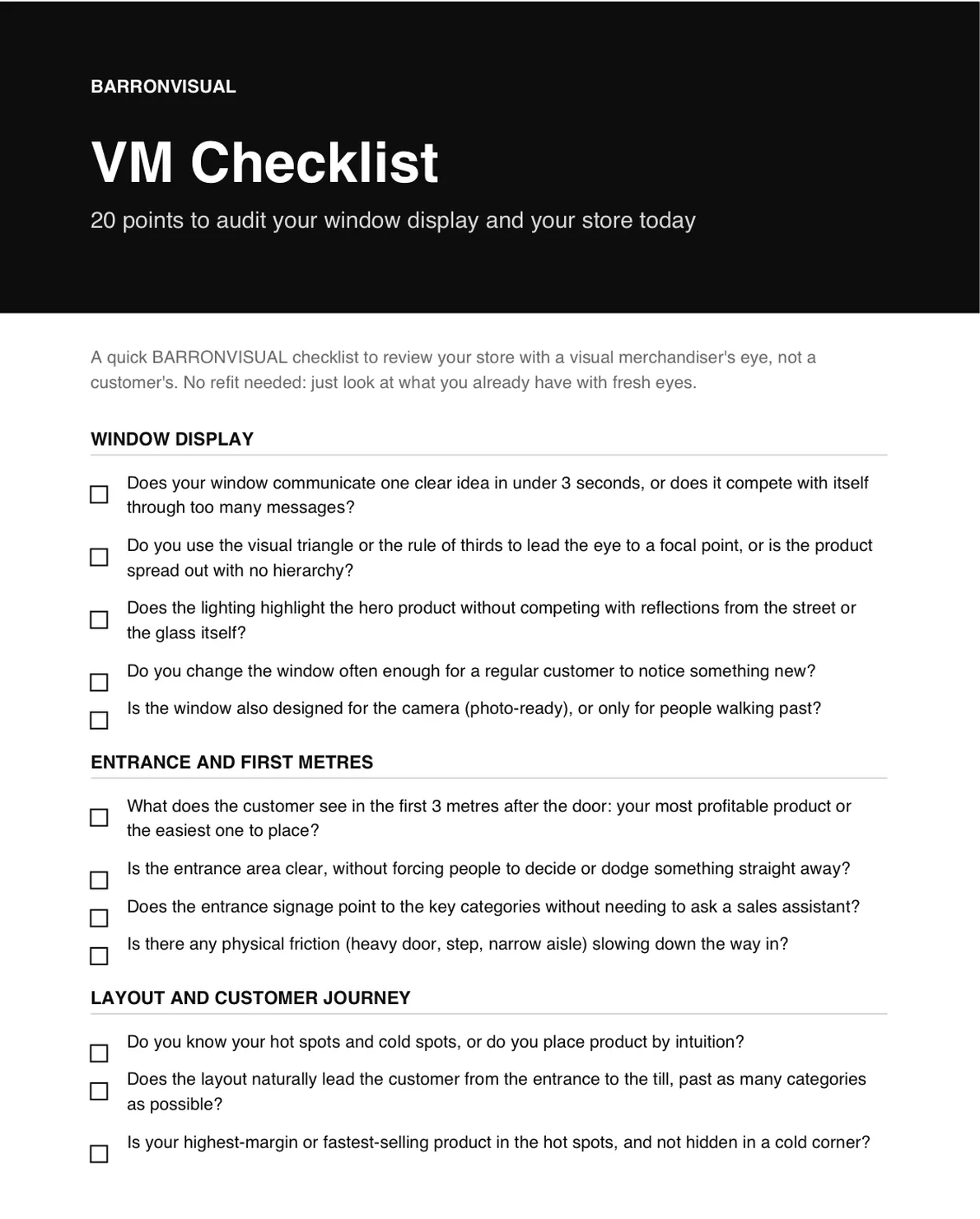
Cover of the BARRONVISUAL VM Checklist PDF

VM Checklist: 20 points to audit your storefront and your store today.

A short PDF to review your store with a visual merchandiser's eye, not a customer's. No renovation needed, just look at what you already have with fresh eyes.

Who are you?

I send you the PDF and, over the following days, 4 short emails to apply it. Unsubscribe in one click.