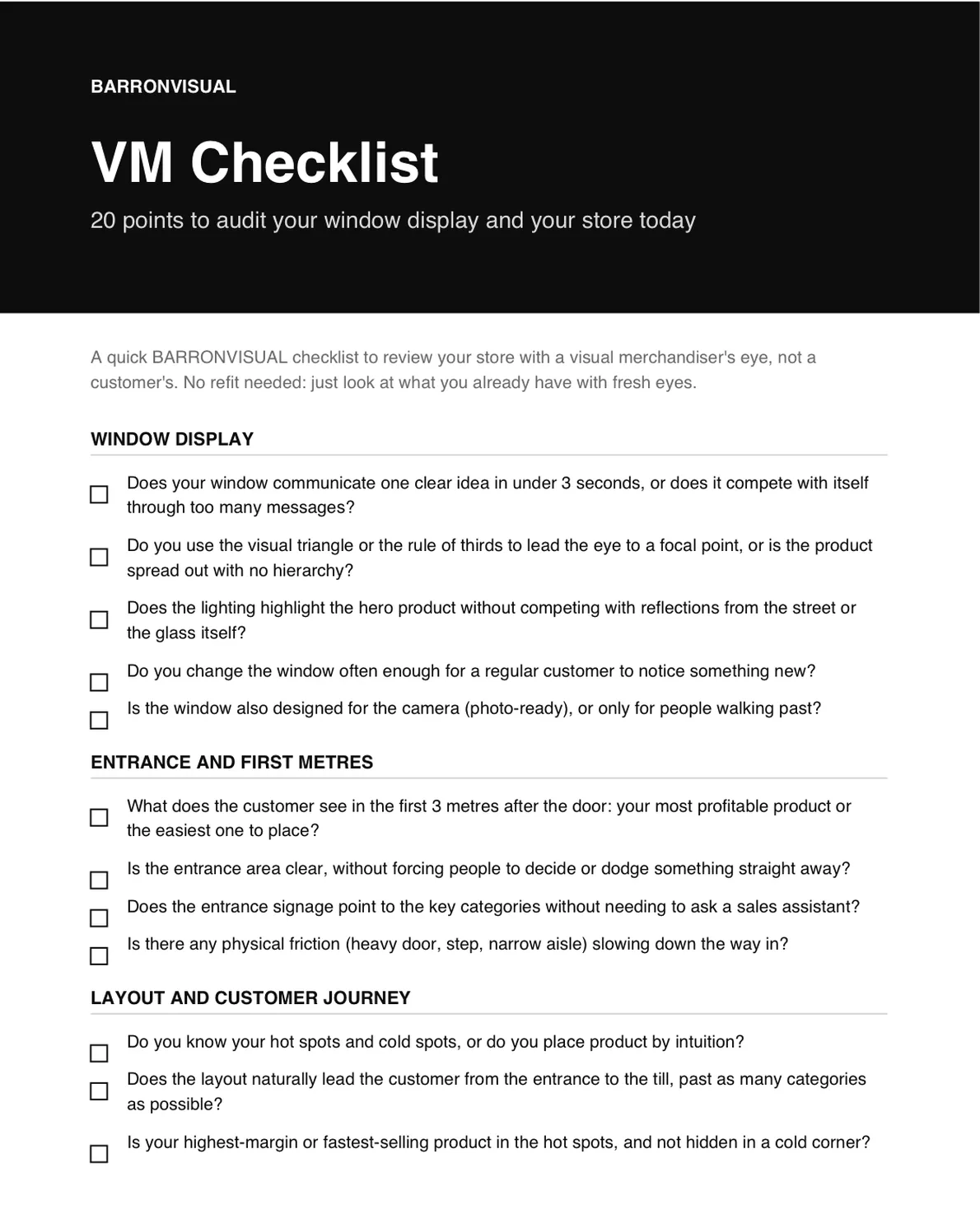
Every week someone writes to me wanting to learn window display without knowing where to start. There are courses for 39 euros and master’s programmes for several thousand, in person and online, with and without a certificate. Before choosing one, it helps to know what you need to learn and in what order. This is what I recommend after 28 years of creating windows for brands such as Chanel, Zara and Galeries Lafayette.
The order I would learn it in
1. Composition: where the eye goes
The first thing is not creativity, it is composition. The visual triangle, the rule of thirds, the hierarchy between a hero piece and the supporting ones. Without this, any brilliant idea turns into noise. It is the foundation of everything else and the thing that shows most when it is missing.
2. Light
A window is seen for many hours under artificial light. Learning to direct light onto the product, avoid reflections and control colour temperature changes the result more than any prop.
3. Colour and materials
Then comes the palette: how colour creates atmosphere, how a product stands out against a background and how materials (wood, paper, metal, fabric) speak of the brand’s level.
4. Storytelling
With the technique under control comes the part that most attracts beginners: telling a story. But a story without composition or light cannot be understood in the three seconds a passer-by gives you. That is why it comes here and not at the start.
5. Product and selling
A professional window is not an art installation: it has to sell. Learn to choose the hero piece, to show the price when it helps, and to connect the window with what the customer finds when they walk in.
6. Measurement
What separates a window dresser from a professional with criteria is knowing whether their work performs: counting how many people pass, stop and come in before and after a change. I explain it in the visual merchandising KPI guide.
Six questions to choose a course
- Who teaches it? Look for someone with real, published windows, not just qualifications.
- Does it teach with real cases? Photos of real windows, with what worked and what did not, are worth more than theory.
- Does it follow an order? If it starts with «creativity» without composition or light, be wary.
- Does it talk about selling? A course that never mentions product, price or measurement trains decorators, not window dressers.
- Is there an assessment? An exam or a corrected exercise forces you to apply what you learn.
- Is the price clear? If you have to ask for information to find out the cost, you already know something about the course.