Sensory Marketing and Window Display: Designing Windows That Move Before They Sell
Juan Carlos Barrón·September 2026·Window Display
The window no longer competes with other stores. It competes with the human brain.
For decades, a good window display was thought to simply be one that showed the product well. A balanced composition, correct lighting and well-dressed mannequins were enough to fulfil its commercial function. But retail has changed radically. Today a window no longer competes only with the store across the street, it competes with hundreds of stimuli fighting for our attention every second. Digital screens, social media, outdoor advertising, traffic, phones and thousands of visual impacts turn the city into a saturated environment where catching a glance has become one of the biggest challenges for any brand.
Our brain can’t consciously process that much information. To survive that overstimulation it develops automatic filtering mechanisms that let it ignore most stimuli and stop only at what it perceives as unexpected, relevant or emotionally significant. That’s exactly where the real work of contemporary window display begins.
An effective window doesn’t get someone to look because it’s pretty. It gets them to interrupt, for a few seconds, the autopilot they walk through the city with. That moment is extraordinarily brief, but enough to decide whether a brand deserves our attention or will go completely unnoticed. In reality, the window’s goal has never been to sell a product. Its mission is to spark enough curiosity that the customer wants to discover what’s happening on the other side of the glass.
From traditional window display to sensory marketing
Visual Merchandising has evolved enormously over the last few decades. In its origins, most of the work focused on purely visual aspects: composition, balance, lighting, colour, proportion, rhythm or hierarchy. All of these elements remain essential, but scientific research has shown they’re only part of a much more complex experience.
Professor Aradhna Krishna, considered one of the world’s leading references in sensory marketing, defines this discipline as «marketing that engages the consumer’s senses and affects their perception, judgment and behaviour». Her work has shown that brands don’t communicate only through advertising messages or rational arguments. They also do it through sensory stimuli that operate almost unconsciously and change the way we perceive a product’s quality, sophistication or value.
This idea completely changes how we understand window display. A window can no longer be considered simply a space to place products attractively. It’s the first contact between a brand’s universe and the consumer’s brain. Even before entering the store, the visitor has already started building expectations about the product’s quality, the company’s positioning, its typical customer profile and even the kind of experience they expect to have inside. Our brain finishes the story long before we’ve actually experienced it.
We like to think we buy rationally. We believe we analyse prices, technical features or comparisons before deciding. But consumer psychology has spent decades showing that most of our decisions begin long before conscious reasoning kicks in.
When we walk past a store, we have barely a few seconds to decide whether it’s worth stopping. In that time, nobody consciously analyses the window’s composition or evaluates the brand’s commercial strategy. What actually happens is much simpler: we feel curiosity, surprise, desire, indifference or rejection. Emotion arrives first, and reason comes later to justify what we’ve already decided intuitively.
That’s why the most effective windows aren’t necessarily the most complex or the ones packed with the most decorative elements. They’re the ones capable of triggering an immediate emotional reaction. An unexpected composition, a shift in scale, theatrical lighting, or a simple void used intelligently can be far more powerful than a window crammed with product. Emotion is the real trigger for attention.
The window as an expectation generator
Before crossing a store’s threshold, the customer has already formed a first opinion of the brand. They do it by interpreting dozens of signals they rarely analyse consciously: the quality of materials, the warmth of the lighting, the amount of product on display, the order of the space, the level of detail or the cleanliness of the composition. Everything communicates.
A window saturated with references conveys abundance, promotion or urgency. A clean space, with few elements and large empty areas, is usually associated with exclusivity, luxury and trust. Neither solution is better than the other. It all depends on the positioning the brand wants to build in the consumer’s mind.
The Visual Merchandiser’s real job is precisely to control that silent language. A mannequin’s height, the distance between two products, a pedestal’s finish or the colour of a background aren’t purely aesthetic decisions. They’re communication tools capable of shifting the customer’s perception in a matter of seconds. Sensory marketing research insists these stimuli work because they activate unconscious associations. We don’t only perceive what we see; we constantly interpret what what we’re seeing means.
Big brands don’t sell products. They build memories.
This is perhaps the biggest lesson we can learn from luxury. Hermès, Loewe, Louis Vuitton, Tiffany or Aesop rarely design a window thinking exclusively about selling the season’s collection. They design scenes capable of expressing an identity. Often the product even stops being the protagonist to become one more element within a much broader narrative.
The goal isn’t to show everything the brand sells. It’s to convey how it wants the customer to feel. Because people don’t remember a window for how much product it contained. They remember how it made them feel. And that’s exactly where sensory marketing begins: the moment a window stops being a commercial display and becomes an experience capable of staying in memory long after leaving the street.
The five senses: retail’s real language
When we think of sensory marketing, we usually imagine a store with a pleasant scent or a carefully chosen playlist. But reducing this discipline to those elements would mean staying only on the surface. Sensory marketing isn’t about perfuming a space or picking the right playlist; it’s about designing a coherent experience where every stimulus reinforces the brand’s identity and helps build a positive perception in the consumer’s mind.
Research carried out over the last few years agrees on one fundamental point: people don’t process stimuli in isolation. Our brain automatically integrates visual, auditory, tactile, olfactory and even gustatory information to build a single perception of the environment. That integration explains why a store can convey sophistication, trust, exclusivity or warmth without saying a single word.
The window is the first step in that process. Even though we can only observe it from outside, it already begins activating expectations about everything we’ll find inside. Even before crossing the threshold, our brain imagines what the atmosphere will be like, the quality of the products, the kind of attention we’ll receive and the profile of people who frequent that store. In reality, the consumer begins living the shopping experience long before entering the store.
Sight starts the conversation, but doesn’t finish it
Sight remains the dominant sense within Visual Merchandising. It’s the first to activate and responsible for capturing attention within seconds. But it would be a mistake to think a window’s success depends solely on its aesthetics.
What really attracts the human brain isn’t beauty understood as perfection, but whatever breaks a pattern. An unexpected composition, a change in scale, theatrical lighting, a large empty space or an object placed out of context all create a disruption in our visual routine. For a few instants we stop walking on autopilot to pay attention to whatever has sparked our curiosity.
The great luxury houses have mastered this principle for decades. Hermès, Loewe or Louis Vuitton rarely try to show an entire collection in the window. They prefer to build a scene, a metaphor or an artistic installation capable of raising questions rather than offering answers. The product stays present, but it stops being the sole protagonist. What matters becomes the story that product helps tell. That shift in approach is decisive: a window stops working as a three-dimensional catalogue and becomes the first chapter of a brand experience.
Smell: the sense that best preserves memories
If there’s one sense especially tied to emotional memory, it’s smell. Numerous studies have shown that scents have an extraordinary capacity to activate memories and emotions stored for years. Just catching a particular fragrance can bring back situations, places or people with surprising intensity.
The most sophisticated brands have understood the enormous potential of that connection. That’s why many of them develop exclusive fragrances that aren’t meant to perfume a store, but to become part of its identity. Just as we recognise a brand by its logo or typography, we can also recognise it by a characteristic scent.
But the real challenge isn’t choosing a pleasant perfume, it’s finding one coherent with the brand’s positioning. A haute couture boutique, an independent bookshop, a natural cosmetics store or a tech store should each communicate completely different sensations. Scent, like architecture or graphic design, must reinforce that personality. When there’s coherence across all the stimuli, the consumer doesn’t perceive the smell as an isolated element. They interpret it as a natural part of the experience.
Sound sets the rhythm of the purchase
Music also changes our behaviour far more than we usually imagine. Numerous studies have shown that tempo, volume and musical style influence how fast we walk, how long we stay inside a store and even how we perceive the value of products.
Not every brand needs the same soundscape. A luxury house seeks to invite contemplation, while a sports store probably wants to convey energy and dynamism. Similarly, a food concept can lean on ambient sounds very different from those of a jewellery boutique. Music thus stops being a decorative element and becomes a strategic tool of commercial design. It doesn’t accompany the experience; it helps build it.
Touch turns perception into reality
Until a customer touches a product, everything belongs to the realm of expectation. The window has sparked interest, the lighting has created a certain atmosphere, and the architecture has built a promise. But physical contact is the moment that promise starts being verified.
The texture of a fabric, the weight of a bag, the temperature of a metal handle or the smoothness of a finish convey immediate information about perceived quality. Our brain uses those small details to confirm or question the image it had built during the first seconds of the visit.
That’s why the best brands put so much effort into selecting authentic materials for their fixtures and display elements. A natural stone surface, well-worked solid wood or carefully brushed steel don’t just serve an aesthetic function. They also communicate values like permanence, precision, craftsmanship or excellence. In contemporary retail, fixtures no longer just support the product. They’re part of the brand’s own discourse.
A sensory experience is never designed in isolation
One of the most interesting findings from Store Atmospherics research is that consumers respond better when all stimuli maintain a coherent relationship with each other. Lighting, scent, music, materials, temperature, the window and staff behaviour shouldn’t be treated as independent decisions, but as pieces of a single system.
When each of those elements sends a different message, an almost unconscious sense of incoherence appears in the customer. Conversely, when they all reinforce the same identity, the experience becomes far more intense and memorable. That’s perhaps the biggest lesson we can draw from major international brands. They don’t design windows, interiors or communication campaigns in isolation. They design complete universes where every detail answers to the same narrative. And that coherence, far more than any technology or advertising spend, is what makes a customer remember a brand long after leaving the store.
The mistakes that destroy any sensory experience
There’s a widespread belief in retail: thinking sensory marketing means adding elements. More music, more decoration, more screens, more lighting, more signage, more scent… But Store Atmospherics research has spent years showing the problem is rarely a lack of stimuli; usually it’s exactly the opposite. Excess information generates cognitive fatigue and makes it harder for the customer to build a coherent experience.
When a store tries to communicate too many things at once, the consumer stops interpreting the brand’s message and starts perceiving only noise. That’s why the world’s best stores aren’t necessarily the most spectacular. They’re the most coherent.
Walking into a Hermès boutique, an Aesop store or an Apple Store produces a very different feeling, but all three share the same principle: every element seems to be part of a single story. Nothing is placed just because. The architecture, the materials, the lighting, the fixtures, the ambient sound and even the staff’s attitude all answer to the same concept. That coherence is probably sensory marketing’s most important ingredient.
The biggest mistake: designing each element separately
For many years commercial design was handled by department. The architect designed the space, the interior designer chose the materials, the marketing department decided on communication, Visual Merchandising placed the product, and another team selected the music or scent. The result was usually technically correct, but rarely built a truly memorable experience.
Today we know consumers don’t perceive a store in parts. They don’t separately analyse the lighting, the window or the fixtures. Their brain integrates all those stimuli into a single overall impression. That’s exactly why Charles Spence and his team insist the real challenge is designing a coherent multisensory atmosphere, where every element reinforces the same brand identity.
A minimalist window loses credibility if the interior is saturated with promotional posters. Similarly, exquisite fixtures lose part of their value if the lighting is cold, flat or unflattering. The customer might not be able to explain what bothers them, but they will perceive that something doesn’t fit.
Emotion isn’t designed. It’s built.
One of retail’s biggest mistakes is trying to trigger emotions artificially. Emotions don’t appear because a store smells pleasant or because a carefully curated playlist is playing. They appear when every stimulus conveys the same message.
Consider, for example, a sustainable fashion house. If the brand talks about craftsmanship, closeness and respect for materials, it would be incoherent to design a store full of giant screens, glossy finishes and loud electronic music. Natural materials, warm lighting, calm acoustics and understated fixtures would reinforce that story far more effectively.
Today’s consumer detects these incoherences with remarkable ease. They might not put it into words, but they feel it. And sensory marketing works precisely on that unconscious perception.
Artificial intelligence won’t replace creativity
The rise of artificial intelligence is changing how we design commercial spaces. Today we can generate window proposals in minutes, simulate materials, test different lighting or visualise concepts before building a single element.
As a designer, I consider this technology an extraordinary opportunity. It lets us present several creative directions to the client, speed up the ideation process and reduce costs during a project’s early stages. But one idea needs to be clear. Artificial intelligence generates images. It doesn’t generate judgment. It doesn’t understand a brand’s identity. It doesn’t understand the urban context a store sits in. It doesn’t interpret a company’s culture or the story it wants to tell. All of that still depends on the designer.
AI is an extraordinary creative tool, but it still needs clear direction, a strategy and a commercial vision. Just as good design software doesn’t automatically turn someone into an architect, artificial intelligence doesn’t replace a Visual Merchandiser’s experience.
The future belongs to Phygital Retail
For years people talked about the disappearance of physical stores. But reality is proving exactly the opposite. What’s disappearing isn’t stores, it’s irrelevant stores. The commercial spaces with a future will be those capable of integrating the physical and digital worlds into a single experience.
The window will attract the customer. The interior will reinforce the emotions. Technology will provide information and personalisation. eCommerce will let the relationship continue after leaving the store. And artificial intelligence will help interpret consumer behaviour to continuously improve that experience.
At BARRONVISUAL we call this vision Phygital Retail: a system where architecture, Visual Merchandising, branding, customer experience, digital design and artificial intelligence stop functioning as independent disciplines and become a single strategy. Because the consumer doesn’t distinguish between the physical and digital worlds. They only remember how a brand made them feel.
Conclusion
Window display has never simply been about placing products behind glass. It has always been a form of communication. What’s different today is that we understand much better the mechanisms that explain why some windows stay in our memory for years while others vanish from it just seconds after we’ve seen them.
The science of sensory marketing confirms something the best visual merchandisers have sensed for decades: people don’t buy only what they need. They buy what moves them, what they identify with and what manages to become part of their memories.
That’s why the most effective window isn’t the most expensive, the most complex, or the one with the most technology. It’s the one that manages to stop someone for a few seconds, spark their curiosity and make them want to discover what’s happening on the other side of the glass. Because, in the end, a good window doesn’t sell products. It sells the desire to walk in.
Free resource
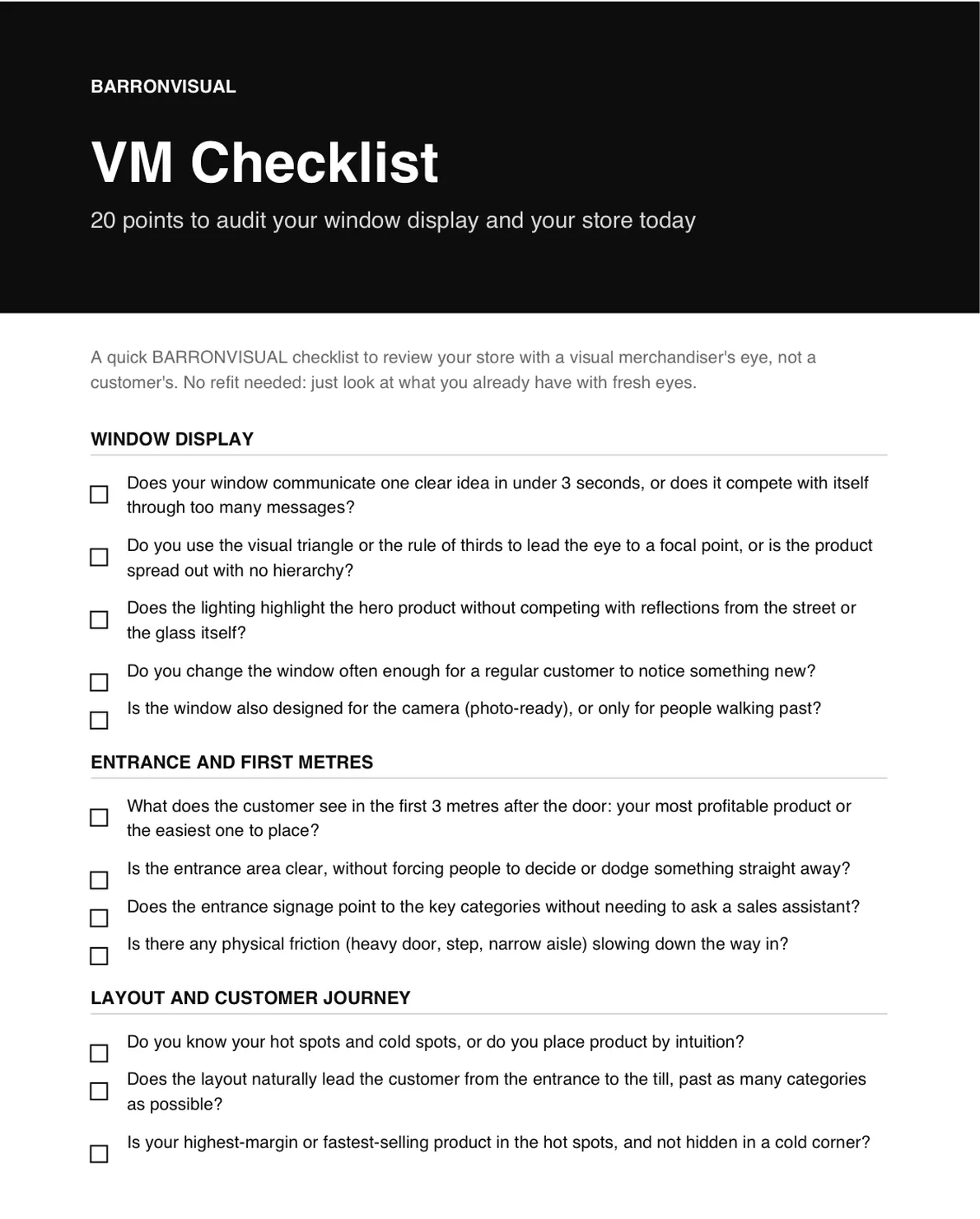
VM Checklist: 20 points to audit your storefront and your store today.
A short PDF to review your store with a visual merchandiser's eye, not a customer's. No renovation needed, just look at what you already have with fresh eyes.
I send you the PDF and, over the following days, 4 short emails to apply it. Unsubscribe in one click.