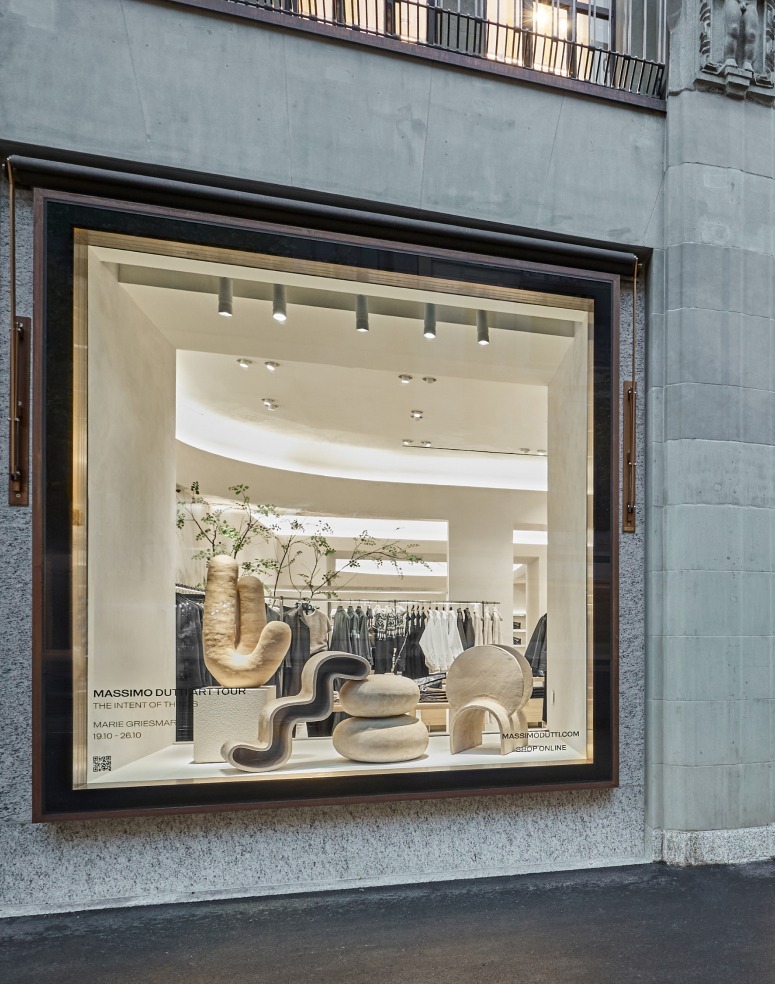
Conceptual window display: the tool that says who you are
The conceptual window has a different job: communicating brand identity before the customer ever comes in to ask anything. The product is present, but it isn’t the sole protagonist, it’s one piece within a scene that conveys a whole universe. It isn’t measured in immediate sales. It’s measured in something harder to quantify but just as real: brand recall, differentiation, desire. A badly executed conceptual window is indistinguishable from a meaningless art installation. A well-executed one is the reason a luxury brand can raise its prices without losing customers.

A vanguard with a name: a brief history of the window as art
This didn’t start yesterday, and no branding agency invented it. The intellectual root of the window as a space of meaning, not sale, lies in the 19th-century Paris studied by Walter Benjamin in his unfinished Arcades Project: the iron-and-glass shopping arcades, and the figure of the flâneur, the stroller who window-shops with no need to buy anything, turning the simple act of looking into an aesthetic experience in itself. That’s where conceptual window display was born, before anyone called it that: the window as spectacle consumed with the eyes, not the wallet.
The leap to explicit artistic vanguard came, among others, from Marcel Duchamp, when in 1945 he designed the window of a New York bookshop to promote André Breton’s book Arcane 17: an altered readymade mannequin, treated with exactly the same conceptual judgment as his museum works. The window stopped being art’s poor relative and became, for the avant-garde artists themselves, one more legitimate medium.
The figure who professionalised that crossover was Gene Moore, artistic director of Tiffany & Co. in New York from 1955 to 1995: forty years, more than five thousand windows. At a time when the norm was to crowd the glass with mannequins and product, Moore did the opposite, near-empty compositions with one or two objects, and he’s credited with several trade «firsts»: mannequins interacting with each other, surrealism brought into the commercial window, and the direct integration of museum artists’ work (Robert Rauschenberg, Jasper Johns) inside a jeweller’s glass. New York’s Fashion Institute of Technology Museum dedicated a full retrospective exhibition to him in 1996. A window display designer, with his own museum show.
In Paris, the equivalent figure is Leïla Menchari, responsible for Hermès’s windows on the Faubourg Saint-Honoré from 1978 to 2013: a hundred and thirty-six windows over thirty-five years, each one a complete world, aluminium horses, mother-of-pearl Moroccan souks, underwater grottoes with shell-covered urns, tents of Moorish cavalry officers, winged horses of gilded glass leaping from giant gems. The Grand Palais dedicated an exhibition to her in her lifetime. When she died in 2020, the press bid her farewell as «the queen» of French window display. None of her hundred and thirty-six windows sold anything directly. All of them sold Hermès for decades.

The window as a system of signs, not decoration
There’s an underlying theoretical reason this works, and it has a name: semiotics. Roland Barthes, in his foundational essay The Rhetoric of the Image (1964), established that an image never communicates only what it literally shows: it builds a «myth», a set of cultural meanings about lifestyle, values and status that go far beyond the object’s physical features. A well-designed conceptual window does exactly that: it doesn’t sell a handbag, it sells the myth of who you are if you carry that handbag. It’s the same logic studied in retail today under the name «store environment as brand language»: the window, the lighting, the colour and the layout of the space function as a non-verbal language capable of positioning a brand without a single word being spoken or written.

The most avant-garde thing in 2026: when the window starts to breathe
The trend dominating top-tier conceptual window display this year has a fairly vivid name: the static window is being replaced by environments that breathe and move. The most cited example is Springtime Sprouts, Hermès’s installation at its Shanghai Maison, designed by the Wang & Söderström studio: 3D printing to create hyperrealistic organic spirits in a moonlit forest where the brand’s scarves turn into moth wings and accessories bloom like flowers over plant-like figures. The piece proves something Gene Moore or Menchari would have loved: that technology can be as poetic as mother-of-pearl or glass, if it’s subordinated to the same old conceptual judgment instead of replacing it.
The other strong 2026 current is what the industry calls «maximalist textures»: the return of fabric, textured photo paper, explicit tactility, as a response to years of cold, minimalist windows. And at the crossroads of both trends, brands like REFY have started designing the window directly as social content: layered scenes designed to work both behind the physical glass and on a phone screen, two media, one visual language. It’s literally the systems-thinking judgment we champion in our post on contemporary visual merchandising, already applied as a standard of the global commercial vanguard.


Why most stores need both, not one
The usual mistake isn’t picking the wrong one, it’s not knowing they exist as separate categories and mixing them without judgment: a window that tries to look beautiful while also showing five offers at once, and ends up achieving neither.
The real solution is almost never «pick a side». It’s alternating with intent: conceptual window when it’s time to build brand (a collection launch, a seasonal campaign, an opening), commercial window when it’s time to sell (sales, clearance, a one-off traffic campaign). The brands that do it best (and here Zara is a real case study, not empty praise) have a calendar that decides in advance which type of window is called for each week, instead of improvising window by window. Gene Moore, for that matter, also designed purely commercial jewellery windows when the moment called for it. The mastery wasn’t in picking one side forever, it was in knowing which side was called for each week.

How to know which one your window needs right now
A simple question helps decide: if someone photographed your window and showed it without the store’s sign, would the brand be recognisable? If the answer is no, you probably need conceptual work, the same kind that turned Menchari into a name in French luxury without her selling a single scarf from the glass. If the window is recognisable but doesn’t generate measurable entries, you need commercial work, the same direct-conversion judgment I worked with at Zara.
At BARRONVISUAL we design both types of window depending on what each moment of the store needs, not on what’s trendy. If you want a diagnosis of which one you’re missing right now, in Consulting that’s exactly what we do, and at the Studio we execute the commission once it’s decided.