Goodbye, Yayoi Kusama: A Tribute to the Artist I Admired Most
Juan Carlos Barrón·September 2026·Visual Arts
Yayoi Kusama died on 14 August 2026 in a Tokyo hospital, at 97. Her studio made the death public on 27 August, with a brief note saying she kept painting until her final days. I need to say this before anything else: I loved her deeply, I admired her enormously. Not as just one more professional reference among others, but as one of the few artists who has genuinely made me rethink what a window display can become. This piece is a tribute, and along the way, a look at what her work changed forever in how a brand space is designed.
The artist who filled the world with polka dots before the world looked her way
Kusama had been painting polka dots and creating her Infinity Mirror Rooms since 1965, long before any luxury brand ever approached her. She was genuine avant-garde in 1960s New York, dropped off the mainstream radar for decades, and returned to the global conversation later in life, her mirror rooms turned into the most photographed backdrop in contemporary art. When Louis Vuitton came knocking in 2012, they weren’t signing an emerging artist. They were signing someone who had spent fifty years building, with no brand’s help, a visual language instantly recognisable anywhere in the world.
2012: the year Louis Vuitton was covered in polka dots
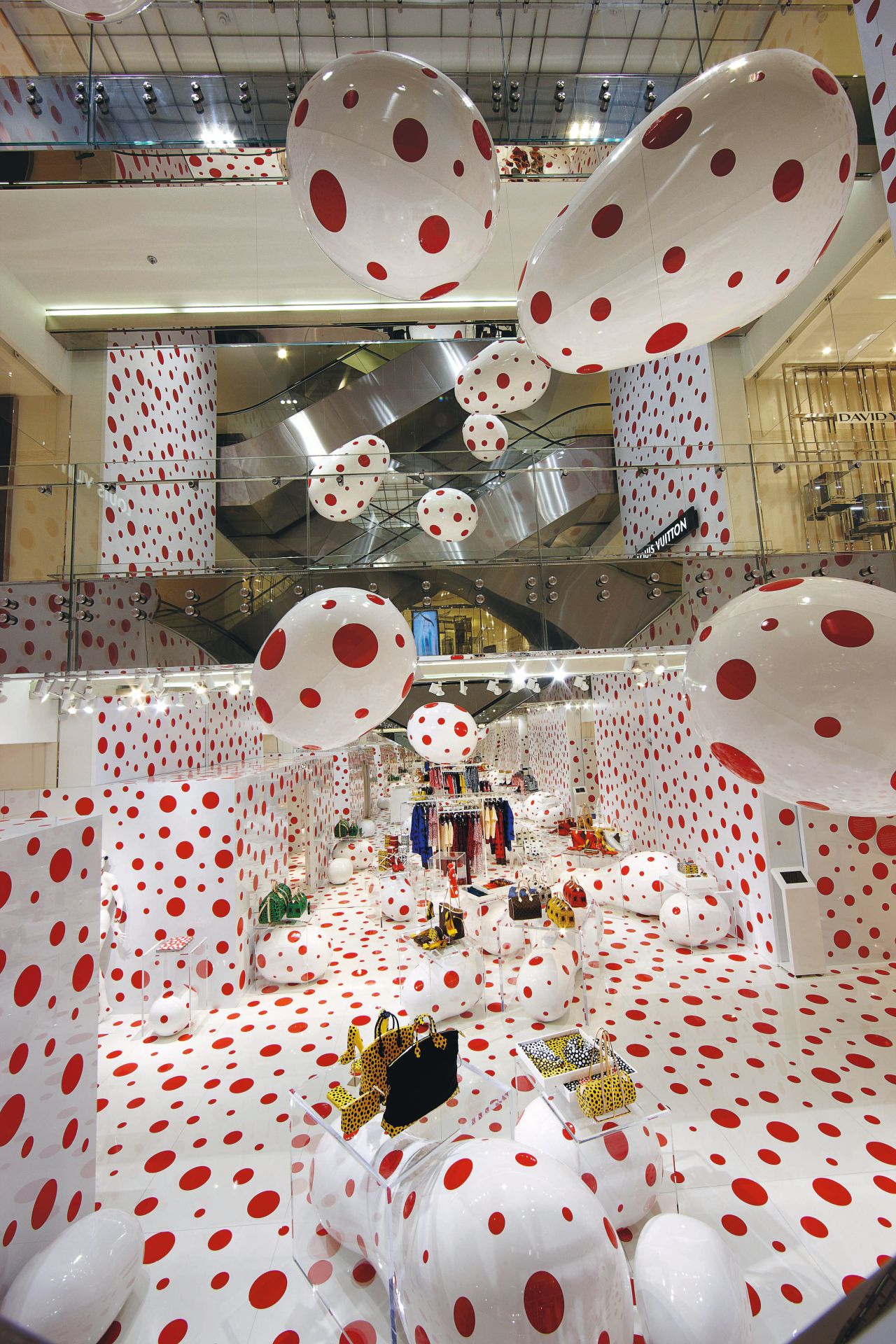
The first collaboration, under Marc Jacobs’s creative direction, did something almost nobody dares do in commercial window display: it emptied the window of product. Before the Dots Infinity collection reached stores, Louis Vuitton windows around the world were covered in Kusama’s polka dots without showing a single bag. It’s the most conceptual move possible: communicating brand identity while selling nothing, generating pure anticipation before the sale. Seven pop-up stores followed (Printemps Paris and Dover Street Market Tokyo among them), and a second wave of pieces with the tentacle motif over the classic monogram.
2023: when the window display stopped being a window display
Ten years later, the collaboration returned with Creating Infinity, more than 450 pieces spanning bags, fashion, fragrance and accessories. In New York, a hyperrealistic robot with Kusama’s face painted polka dots live in the Fifth Avenue window, brush in hand, holding a Capucines bag. But the piece that struck me most was the Harajuku, Tokyo pop-up: two entire floors turned into a world of their own, with a giant statue of the artist presiding over the space and a forest of mirrored spheres directly evoking her Infinity Mirror Rooms.
Louis Vuitton x Yayoi Kusama pop-up, Harajuku, Tokyo (2023). Photo: Hypebeast
On the Champs-Élysées in Paris, a giant inflatable figure of Kusama crowned the facade, one arm extended painting polka dots over the flagship store’s windows. In several cities around the world, augmented reality carried her polka dots onto monuments that had nothing to do with a store. The window display stopped being the boundary of the brand space.
Immersive interior inspired by Kusama’s Infinity Mirror Rooms, Harajuku, Tokyo (2023). Photo: Hypebeast
Why this matters for the craft, not just for art
In an earlier post on this blog we drew a line between conceptual window display and commercial window display. Kusama at Louis Vuitton is probably the most extreme example of conceptual window display ever done at that scale: zero visible product at the moment of greatest impact, and yet, the campaign with the strongest brand recall of the last decade in luxury fashion. It proves something many window designers forget under the pressure of selling this week: the brand that allows itself a window that sells nothing is, sometimes, the one that sells the most afterwards.
There’s a second, quieter lesson. Kusama’s visual language travelled from the museum to the street, from the street to the window, from the window to the bag, without losing an ounce of its identity at any step. It’s exactly the systems-thinking judgment we champion in this studio: that the same focus, the same hierarchy, the same story hold up seamlessly at every touchpoint with the customer. Kusama did it without knowing she was teaching visual merchandising. She simply did it by staying true to her own language for sixty years.
What remains
Kusama didn’t design window displays. She designed a world so complete and recognisable that the biggest brands on the planet lined up to have that world occupy, even for a month, their own. That’s the yardstick any conceptual window display project should be measured against: not how much it resembles Kusama, but whether it has an identity strong enough that someone, someday, might want to lend it their entire facade. Thank you for the polka dots, Yayoi. You will be deeply missed in this craft.
Free resource
VM Checklist: 20 points to audit your storefront and your store today.
A short PDF to review your store with a visual merchandiser's eye, not a customer's. No renovation needed, just look at what you already have with fresh eyes.
I send you the PDF and, over the following days, 4 short emails to apply it. Unsubscribe in one click.