It’s Not Just Shein: Fast Fashion Has a Name and Surname
Juan Carlos Barrón·September 2026·Opinion
France is starting to penalize ultra fast fashion. But if we really want to change the industry, we’ll have to look at Zara, H&M, Primark, Mango, Uniqlo, Amazon… and even luxury itself.
There’s something I like about what’s happening in France: a real price is finally being put on the impact of certain fast fashion models.
The penalty against ultra fast fashion took effect on September 1, 2026, after a legislative journey considerably longer and more troubled than is usually told. The French Senate already gave a first version of the text the green light in June 2025. The European Commission then blocked the process for months, judging in 2026 that the bill clashed with single-market rules and EU eCommerce regulations. The French Parliament didn’t give it final approval until June 2026, with the text already adjusted to Brussels’ objections.
The penalty, designed as a bonus-malus surcharge added to each item’s price, starts in 2026 at up to €12 per item and will rise progressively to €19.50 by 2030. The law explicitly targets ultra fast fashion platforms (Shein, Temu and AliExpress chief among them) and, deliberately, leaves «traditional» fast fashion chains like H&M, Zara or Kiabi out of the surcharge.
I’m in favor.
But I have a problem with how we’re framing the conversation.
I think it falls short.
Because the problem isn’t just Shein.
Nor just Temu.
Nor just ultra-fast fashion.
The problem is a much broader system of production, distribution, marketing, retail and consumption that we’ve been building for decades.
Amazon. AliExpress. Frictionless eCommerce. The «I want it now» culture. Constant collections. Stores that get refitted every few years. Windows that get dismantled every season. Disposable fixtures.
And yes: also certain premium and luxury brands that have started adopting speed dynamics that look far too much like fast fashion’s.
Because if we really want to talk about sustainability, we can’t limit the conversation to who sells the cheapest t-shirt.
We have to ask ourselves something much more uncomfortable:
How much are we producing, how much are we buying, and how much are we destroying, simply to keep a machine running that needs to constantly sell something new?
19 kg
of clothing, footwear and home textiles bought per person in the EU in 2022
17 kg
was the same figure in 2019, three years earlier
Source: European Environment Agency (EEA).
So reducing this whole conversation to Shein would be too convenient.
Because the problem is precisely this: we’ve learned to consume far too fast.
Ultra-fast fashion didn’t invent the problem
When we talk about ultra-fast fashion, the names come up immediately.
Shein. Temu. Boohoo.
And rightly so.
They’re especially aggressive models in terms of speed, volume, price, catalogue turnover and use of digital platforms to stimulate demand.
But there’s something fundamental we shouldn’t forget:
Shein didn’t invent fast fashion. It took it to another speed.
Zara already existed before.
H&M already existed.
Primark already existed.
A fashion model based on shrinking the time between trend, production, distribution and purchase already existed.
The difference is that ultra-fast fashion platforms have taken that logic much further through technology, data, algorithms, social media and an extraordinary ability to detect and quickly reproduce whatever is generating attention.
The European Union itself has spent years analyzing the problem from a much broader perspective. The European Environment Agency considers textile consumption to be among the consumption categories with the highest environmental and climate pressure in Europe. In 2022, each EU citizen bought an average of 19 kg of clothing, footwear and home textiles, up from 17 kg in 2019.
So reducing this whole conversation to Shein would be too convenient.
Because the problem is precisely this: we’ve learned to consume far too fast.
Zara and Inditex: speed turned into competitive advantage
If we’re talking about fast fashion, we can’t avoid talking about Zara and Inditex.
And I want to do so carefully, because I consider Inditex’s model, from a business and retail standpoint, to be extraordinarily sophisticated.
Which is precisely why it’s so important to analyze it critically.
Zara transformed the industry because it managed to connect information, design, production, logistics, distribution, stores and demand in an extraordinarily efficient way.
Speed became a competitive advantage.
The ability to react to what was happening in the market allowed it to reduce certain risks and get product to stores quickly.
From a retail standpoint, it’s a genuine masterclass.
But here comes a question I consider unavoidable:
What happens when an extraordinary ability to produce and distribute quickly stops being used solely to respond to demand and starts contributing to creating a culture of permanent demand?
Because we can use efficiency to produce better.
But we can also use it to produce a lot more.
And that difference is crucial.
I’m not saying Zara is Shein.
It isn’t.
I’m saying we can’t use Shein’s existence to automatically make everything that existed before it sustainable.
Fast fashion has a history that predates ultra-fast fashion.
For years, H&M’s model has demonstrated the enormous commercial power of combining fashion, affordability, frequent renewal and very dynamic communication.
Designer collaborations. Special collections. Campaigns. New arrivals. Seasons. Capsules. Promotions.
All of it turns novelty into a fundamental tool for traffic and desire.
And here’s the problem.
When novelty becomes the main reason to buy again, the consumer starts learning that what they have stops being enough simply because something new has appeared.
That’s a form of obsolescence.
Not necessarily technical.
Not necessarily functional.
Cultural obsolescence.
And it’s tremendously powerful.
Primark and Lefties: when price makes consumption easy
Then there’s Primark and Lefties, two names that also have to be part of any honest conversation about the low-price, high-turnover fashion ecosystem.
A cheap t-shirt isn’t automatically bad.
And an accessible price can have an important social function.
The problem appears when an extremely low price combines with a culture of use, replace and buy again.
If a garment costs so little that it’s economically easier to replace than to repair, we’ve created a very powerful incentive against repair.
That’s why I find it especially interesting that the new French legislation has incorporated criteria related to repairability and other aspects of the business model.
Because maybe we should start changing the question.
Not: «How much does this t-shirt cost?»
But: «How much does it cost per year I use it?»
A €20 garment that lasts ten years can have a completely different logic from a €5 garment we wear three times.
Mango and ASOS shouldn’t disappear from the conversation either
Here too I want to avoid selective criticism.
Mango has to be part of the conversation about the evolution of fast fashion and contemporary fashion retail.
Not because it’s equivalent to Shein.
It isn’t.
But because the big fashion chains have taken part in a general transformation of product rhythms, collections, the commercial calendar and purchase frequency.
We can say the same of ASOS.
eCommerce has enormously widened catalogue breadth and sped up the cycle between trend, exposure and purchase.
And here’s something I consider fundamental:
Digitalization can make us consume better, but it can also make us consume a lot more.
The European Environment Agency states it explicitly: digital technologies can improve efficiency and reduce waste, but they can also increase production and consumption through social media and online platforms.
Technology isn’t automatically sustainable.
It depends on what we use it for.
Uniqlo and the need to distinguish between models
Uniqlo deserves particular consideration.
It wouldn’t be rigorous to lump it in with Shein without qualification.
Its product proposal, its basics philosophy and its positioning are different.
But that doesn’t mean it’s outside the debate on the global textile industry, large-scale production, materials, distribution and consumption.
And this distinction seems important to me because serious criticism doesn’t mean calling everything fast fashion.
It means analyzing what production and consumption model lies behind each brand.
Before continuing
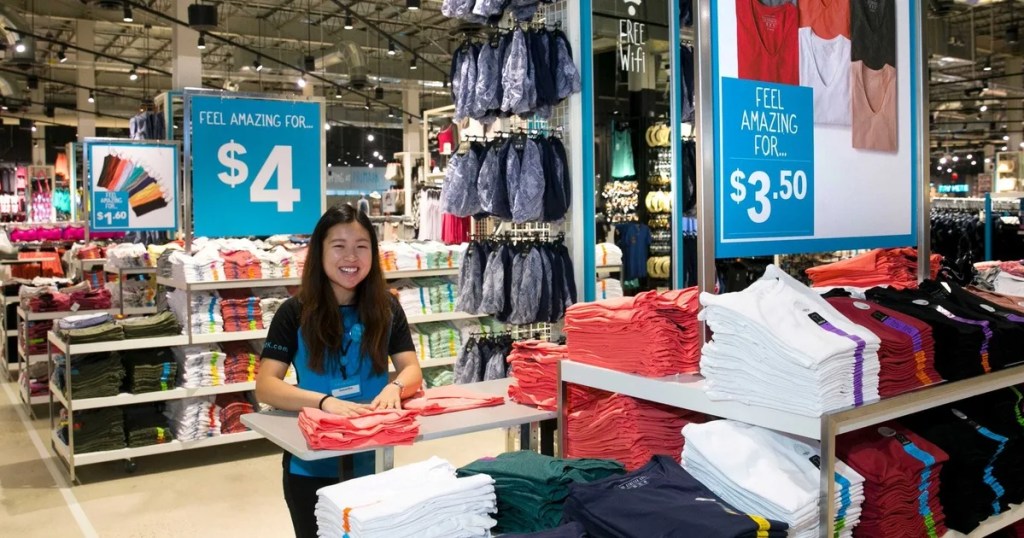
I don’t want to write a «bad brands» article. I want to do something more uncomfortable: analyze a system with many degrees of responsibility.
Ultra-fast fashion: Shein, Temu and Boohoo
And now we get to the most extreme cases.
Shein. Temu. Boohoo.
Here speed reaches another dimension.
The combination of eCommerce, algorithms, data, social media, extremely low prices and constant renewal makes for an extraordinarily effective machine for turning attention into purchases.
The problem is that this same efficiency can fuel overconsumption.
The user doesn’t need to go to a store.
They don’t need to wait for a new season.
They don’t even need a clear intention to buy.
They can discover a product while consuming content.
Tap. Buy. Receive. And start again.
We’ve gone from fast fashion to fast consumption.
And I find that even more worrying.
Amazon: the problem of frictionless buying
And here I want to widen the conversation even further.
Because if we’re talking about accelerated consumption, we can’t ignore Amazon.
Amazon isn’t a fast fashion brand.
It would be absurd to say so.
But Amazon has enormously contributed to normalizing an idea with deep consequences: that practically anything should be immediately available.
I want it. I buy it. It arrives. And if I don’t like it, I return it.
Friction disappears.
And when friction disappears, part of our perception of the real cost of the purchase can disappear too.
~20%
of clothing bought online in the EU gets returned
22-43%
of those returns may end up destroyed (central estimate: about a third)
Source: European Environment Agency (EEA).
This doesn’t mean every Amazon return ends up destroyed.
Far from it.
But it shows that the eCommerce system built on mass purchasing and returns has a structural problem we need to address.
And most importantly: the problem isn’t solved just by making transport more efficient.
We have to attack the root: overproduction + oversupply + overconsumption.
AliExpress and the democratization of the cheap object
Something similar happens with AliExpress.
It’s not fast fashion either.
But it’s part of a global eCommerce ecosystem that has made it possible to acquire enormous quantities of products at extremely low prices.
And this forces us to widen the concept.
Because maybe the great problem of the 21st century isn’t just fast fashion.
Maybe it’s: FAST CONSUMPTION
Fast fashion
A textile production model that compresses to the maximum the time between trend, manufacturing, distribution and sale. It has a name and surname: Zara, H&M, Primark, Mango, Uniqlo, ASOS, Lefties.
Fast consumption
A frictionless, impulsive, permanent consumption pattern, fueled by algorithms, social media and instant logistics. It doesn’t need to be fashion: it applies just as much to Shein as to Amazon or AliExpress.
Fast consumption. Cheap products. Low friction. Global shipping. Permanent novelty. Accelerated obsolescence. Impulse buying. And replacement.
The t-shirt isn’t the isolated problem.
The problem is the system that makes it seem reasonable to buy it, use it a few times, and replace it immediately.
And now comes the most uncomfortable part: luxury is accelerating too
This is where I think the conversation gets really interesting.
Because it would be very easy to point at Shein and feel morally superior.
But no.
Luxury has also started adopting speed dynamics.
We can’t say Gucci is Shein.
Nor that Burberry is Zara.
Nor that Balenciaga is Boohoo.
That would be an absurd simplification.
But we can talk about a phenomenon the industry has described as the «fast-fashionization» of luxury: the incorporation of dynamics like speed-to-market, higher launch frequency, capsules, collaborations, drops and an increasingly fast response to cultural trends.
And this worries me especially.
Because historically, luxury represented almost exactly the opposite.
Time. Craftsmanship. Scarcity. Permanence. Savoir-faire. Slowly built desire.
If luxury needs to chase TikTok to stay relevant, something has changed.
Burberry and «See Now, Buy Now»
Burberry was one of the most visible cases of this shift.
Fashion’s traditional system involved a considerable wait between the runway show and commercial availability.
The See Now, Buy Now model tried to close that gap.
You see it. You want it. You buy it. Now.
From a commercial standpoint it’s perfectly understandable.
But culturally it raises a fascinating question: What happens to luxury when we eliminate the wait?
Immediacy is one of the great values of the digital economy.
But waiting can also be part of the value.
Business of Fashion and other industry media have analyzed how the calendar shift and the pressure to speed up availability transformed fashion’s traditional rules.
Its ArtLab in Italy was conceived as an advanced center to develop and manufacture leather goods and footwear, boosting innovation capacity and cutting development times.
And I want to make a fundamental distinction here: speed isn’t bad.
Speeding up a process can mean reducing errors. Reducing waste. Producing on demand. Improving planning. Optimizing inventory.
Technology can be an extraordinary tool for sustainability.
The problem appears when speed is used to feed a permanent need for more novelty.
The question shouldn’t be: Can we manufacture faster?
The question should be: Do we need to manufacture more?
Balenciaga and the trend economy
Balenciaga represents another phenomenon.
The brand has shown an extraordinary ability to turn cultural codes, memes, urban aesthetics and digital trends into luxury products.
From a creative and marketing standpoint, it’s brilliant.
But it also shows how much contemporary luxury can depend on something extremely volatile: immediate cultural relevance.
What’s viral today can look completely spent tomorrow.
And the faster culture changes, the faster a brand that depends on it has to react.
And there, fast fashion’s logic reappears: trend → product → desire → purchase → new trend.
The price can be ten times higher.
The logo can be far more powerful.
The materials can be better.
But the logic of accelerated novelty can still be there.
Accessible luxury isn’t fully off the hook either
We also find brands like Coach, Michael Kors, Ralph Lauren or Tory Burch here, each with different models and positioning.
It wouldn’t be serious to directly call them fast fashion.
But we can analyze how the premium and accessible luxury segment has had to compete in a market where the consumer expects constant novelty.
And that has a consequence: visit frequency becomes a commercial metric.
You have to get the customer to come back.
And to get them to come back you need new arrivals.
And to have new arrivals you need product.
And to produce product you need resources.
And here the circle closes again.
COS and Massimo Dutti: visual luxury doesn’t guarantee circularity
There’s another issue I find fundamental.
A brand can have an extremely sophisticated aesthetic and still operate within a high-volume structure.
COS. Massimo Dutti. H&M Studio.
They’re interesting examples of how premium aesthetics can coexist with business structures born in the world of mass fashion distribution.
And this shows something we should always remember: a brand’s look doesn’t necessarily tell us its impact.
A store can have natural stone. Wood. Metal. Architectural lighting. Scent. Silence. Minimalism.
And look completely sustainable.
But that tells us nothing about: how much product it produces; how much stock it generates; how long it lasts; what happens to the surplus; what materials it uses; how it’s manufactured; how it’s transported; or what happens when the product stops selling.
Sustainability isn’t an aesthetic.
And here luxury should be exactly the opposite
This is my personal and professional opinion.
If luxury wants to keep making sense in the 21st century, it should recover an idea that seems to have been lost: permanence.
A luxury piece should deserve to be kept.
A bag should be repairable.
A jacket should be inheritable.
A shoe should be maintainable.
A piece of furniture should be able to last decades.
A store should be able to evolve without being torn down.
And a window display should be able to transform without constantly generating waste.
Because if luxury ends up working under the same psychological logic as fast fashion (novelty, urgency, trend, replacement), we’ll simply be charging a lot more money for a similar consumption dynamic.
And that doesn’t interest me.
The problem doesn’t end with the product
And here we get to my professional territory: retail.
Because when we talk about sustainability in fashion we usually talk about the garment.
But there’s another system around the product: the store.
The window. The fixtures. The interior design. The lighting. The decor. The packaging. The merchandising. The visual merchandising.
And all of that consumes resources too.
The store also has a footprint
A store doesn’t appear out of nowhere.
Building it requires: materials, transport, manufacturing, installation, lighting, fixtures, cladding, technology and energy.
And then a day comes when the brand decides the visual concept is outdated.
So: it gets dismantled. thrown away. another gets built. another gets installed.
And the cycle starts again.
Why have we accepted this as normal?
Why does a perfectly functional store have to become obsolete just because the brand concept changed?
Why do we have to destroy fixtures that could be transformed?
Why don’t we design from the start with a second, third or fourth life in mind?
There’s an enormous opportunity here.
Arup has been pointing out for years, precisely, the need to apply circular economy principles to retail fit-out: designing stores to facilitate disassembly, reuse, updating, remanufacturing and recycling of their components.
And yet, this conversation still gets far less attention than product sustainability.
The window display is also part of the problem
I love window displays. I love scenography. I love a great idea. I love the ability to turn a facade into an experience.
But that’s exactly why I want our profession to be much more demanding.
A spectacular window shouldn’t have to depend on tons of disposable materials.
We don’t need to manufacture more to be more creative.
We need to design better.
An element can be transformed. A structure can be reused. A module can change position. A graphic can be updated. Lighting can be adapted. An object can serve several campaigns. A material can have five lives.
That’s creativity.
We need Circular Visual Merchandising
I’d call it: CIRCULAR VISUAL MERCHANDISING
A visual merchandising that keeps the commercial and emotional impact but builds in circularity criteria from the start.
It doesn’t mean making boring windows.
It doesn’t mean eliminating creativity.
It doesn’t mean every store has to look the same.
It means designing with an extra question: What will happen to all of this when the campaign ends?
That question should be asked before manufacturing the element, not after dismantling it.
Fewer things. More design.
For too long we’ve confused visual impact with quantity.
More product. More fixtures. More decor. More messages. More elements. More stimuli.
But a great designer should be able to achieve more impact with fewer resources.
And this, paradoxically, is much harder.
Because it requires thinking. It requires strategy. It requires understanding the consumer. It requires understanding composition. It requires mastering space. It requires knowing what to remove.
Sustainability should make us better designers, not less imaginative ones.
And we also have to rethink merchandising
Here’s another point I consider fundamental.
Merchandising decides what product exists in the store, how much stock we need, how deep the assortment is, when it arrives, where it’s allocated and when it’s pulled.
Visual merchandising translates that product into space.
Both disciplines work with many of the same KPIs: sales, conversion, margin, turnover, stock productivity.
But they use different levers.
And that’s why we have to start working together.
Because if merchandising decides we need thousands of SKUs, the visual merchandiser will have to find a way to show them.
If the commercial calendar demands constant novelty, the window will have to change constantly.
If the store gets refitted every few years, the interior designer will have to redesign it.
Everything is connected.
What if the goal were to sell more without producing more?
This question seems much more interesting to me than «how do we get people to buy more?»
Because maybe the real challenge of sustainable retail is: increasing the value generated by each unit produced.
It’s believing the only way to grow is by constantly producing more units.
Maybe we can grow by generating more value per unit.
More brand value. More margin. More loyalty. More durability. More experience. More conversion. More service. More repair. More second life.
The fashion industry can’t just look at the planet when the sustainability campaign comes around
The European Environment Agency notes that European textile consumption puts considerable pressure on raw materials, water, land and climate.
234M t
of raw materials used in 2022 for textiles consumed by EU households
523 kg
equivalent per person, in raw materials alone
Source: European Environment Agency (EEA).
And we’re not just talking about CO₂.
We’re also talking about water. Land. Chemicals. Microplastics. Waste. Biodiversity. And people.
The global textile chain employs millions of workers, and much of the production destined for European consumption happens outside Europe. The European Environment Agency notes that the impacts of our demand largely occur outside European territory.
That’s why I’m not interested in the «my brand is sustainable because we use recycled cotton» narrative.
The question has to be much bigger.
How much are we producing?
This is the question we should put on the table.
Because we can manufacture a garment with the most sustainable material in the world.
But if we produce five times more garments than we need, we still have a problem.
4-9%
of all textile products sold in Europe could be destroyed before ever being used: between 264,000 and 594,000 tonnes a year (EEA estimate for 2020).
This is absolutely brutal.
Because it means we’ve used: water, energy, raw materials, labor, transport, packaging, space, marketing, time and money to produce something that, in some cases, never even gets used.
And that’s not efficiency.
It’s industrial waste.
The true luxury of the future will be permanence
That’s why I believe the future of luxury should be radically different.
Not more products. Better products.
Not more collections. Better collections.
Not more refits. More adaptable stores.
Not more disposable window displays. Reusable visual systems.
Not more artificial urgency. More desire.
Not more obsolescence. More permanence.
Because maybe the true luxury of the future isn’t having immediate access to something.
Maybe it’s having something that still holds value twenty years from now.
France has started. Now it must continue
That’s why I strongly support French regulation.
But I want it to go much further.
I don’t think we should settle for penalizing Shein and Temu while leaving an enormous part of the production and consumption system we’ve built untouched.
The criticism shouldn’t be: «Shein is bad.»
That’s too easy.
The important question is: What elements of our business model allowed Shein to succeed?
Because if the consumer was already used to constant novelty, low prices and immediate availability, Shein didn’t appear out of a vacuum.
It found perfectly prepared ground.
And you only have to look at what’s happening around France’s own malus to confirm it: even when a government manages to pass a real penalty, the rest of the European system remains far behind.
The case of the Scrap, France’s textile extended-producer-responsibility and collection system, is a good example. The French government itself asked Refashion, the eco-organization managing that system, to submit an action plan to introduce specific penalties against ultra fast fashion. But the final design of those surcharges has been delayed three more months than planned by objections filed by the European Commission, exactly the same friction with Brussels that already delayed the malus law itself for months. A system designed to make high-volume producers economically accountable keeps, year after year, looking «beyond» the date it should already be working.
And it’s not the only front where the European response falls short.
Since July 1, 2026, the European Union applies a flat €3 fee to low-value packages arriving from outside the EU, designed precisely to slow the flood of cheap shipments from Shein, Temu and AliExpress. It’s a real step. But the European textile industry itself, represented by Euratex, has made clear in forums like Première Vision that «we can’t stop there»: they’re demanding a €10 handling fee per package, one that should also go specifically toward strengthening customs controls rather than being diluted into the EU’s general budget.
5.9 B
low-value packages entered the EU in 2025, 93% from China
€3
flat fee in effect since July 2026 per non-EU package
€10
fee Euratex is demanding to actually fund customs controls
Sources: FashionNetwork and Euratex.
Almost 16 million low-value packages enter the European market every day, and with a €3 fee, the margin for continuing to sell at rock-bottom prices, with constant catalogue renewal, is barely dented.
What’s missing, looking at the three pieces together
A malus that rises in stages through 2030, a textile producer-responsibility system delayed another three months by objections from Brussels, and a package fee the European industry itself considers insufficient. None of the three pieces is useless. But none, separately or together, matches the speed of the problem they’re trying to slow down.
And here I also include the luxury industry
I don’t want an article that says: «Fast fashion is bad and luxury is good.»
That would be false.
Luxury also has to look in the mirror.
When a premium or luxury brand speeds up its collections, multiplies capsules, uses constant drops, chases microtrends and turns permanent novelty into an essential sales tool, it’s psychologically moving closer to the very accelerated-consumption culture it criticizes when talking about fast fashion.
It doesn’t mean it’s the same model.
But it does mean we should ask ourselves questions.
How much is enough?
How much product does a brand really need?
How many new arrivals does a consumer really need?
How many collections does a luxury house really need to stay relevant?
And above all: what are we losing when speed becomes an obsession?
The next big challenge for Visual Merchandising
I think there’s an enormous opportunity here for our profession.
The visual merchandising of the future can’t limit itself to making a store sell more.
It has to learn to make a store sell better.
That means: more conversion, more experience, more clarity, more storytelling, more suitable product, better space, less waste.
And it means designing windows and stores that can evolve.
Retail’s next revolution won’t be producing faster
It will be learning to produce less and sell better.
It will be using data to reduce overproduction.
It will be designing products to last.
It will be repairing instead of replacing.
It will be reusing instead of throwing away.
It will be designing stores to be disassembled.
It will be designing windows to be transformed.
It will be designing fixtures to have several lives.
It will be using creativity to generate desire without multiplying waste.
And it will be understanding that the planet is also part of the bottom line, even though it didn’t appear on the spreadsheet for decades.
I don’t want fashion without creativity
I want to end with something important.
I don’t want to eliminate fashion.
I don’t want cities without window displays.
I don’t want boring stores.
I don’t want to end creativity.
I don’t want every brand to look the same.
I want exactly the opposite.
I want us to be much more creative.
Because when you have infinite resources, anyone can do something spectacular.
Real talent appears when you have to achieve enormous impact with much less.
A designer who needs 500 elements to build a spectacular window can be good.
But a designer who makes five elements unforgettable can be extraordinary.
And that’s the kind of creativity I think we need.
Creating desire without creating waste
This is probably one of the questions that interests me most to raise from visual merchandising and retail.
Not: how do we get people to buy more?
But: how do we make each purchase worth more?
Not: how do we change the window every week?
But: how do we design a visual system that can evolve over years?
Not: how do we produce more SKUs?
But: how do we sell the SKUs we really need better?
Not: how do we make a store look new every three years?
But: how do we design a store that can stay relevant for twenty?
Less fast fashion. Less fast consumption. Less waste.
I’m in favor of France having started to act against ultra-fast fashion.
But I want the debate to continue.
To reach Zara and Inditex. To reach H&M. To reach Primark. To reach Uniqlo. To reach Mango. To reach ASOS. To reach Lefties. To reach Boohoo. To reach Shein. To reach Temu.
To reach Amazon and AliExpress when we talk about accelerated consumption and frictionless commerce.
And to reach luxury too.
Gucci. Burberry. Balenciaga. Coach. Michael Kors. Ralph Lauren.
All the brands that, to a greater or lesser extent, are experimenting with an industry demanding ever more speed.
Not to point fingers.
To demand more from all of us.
Because sustainability can’t be a competition to decide who’s least bad.
It has to be a transformation of the system.
The future shouldn’t be producing more. It should be creating more value.
More durability. More repair. More reuse. More design. More creativity. More intelligence. More experience. More strategy.
Less unnecessary product. Less waste. Less obsolescence. Fewer disposable stores. Fewer disposable window displays. Less automatic consumption.
And much less waste.
Because maybe the great challenge for 21st-century retail isn’t getting the consumer to buy more.
Maybe it’s achieving something much harder: getting them to buy better.
And from my point of view, that’s where visual merchandising, merchandising, store design, window display, eCommerce and phygital retail have a great deal to contribute.
Because designing the future of retail isn’t only about deciding what we’re going to sell.
It’s also about deciding what world we’re helping to build every time we get someone to buy something.
Creating desire without creating waste.
More value. Less resource consumption.
More design. Less waste.
That should be the industry’s next great challenge.
Sources and reference data
The European Environment Agency places European textile consumption among the categories with the highest environmental and climate pressure, and points to the need to shift from fast fashion toward better, more durable, reusable and repairable products.
The EEA’s latest data indicate that in 2022 European textile consumption reached an average of 19 kg per person, and that the textile chain places significant pressure on raw materials, water, land, emissions, chemicals and microplastics.
The EEA also estimates that between 4% and 9% of textiles sold in Europe may be destroyed before ever being used, while returns and surplus are among the textile trade’s biggest circularity problems.
And beyond the garment, store design itself also needs to evolve: circular fit-out principles propose designing commercial spaces to facilitate disassembly, reuse, updating, remanufacturing and recycling of their components.
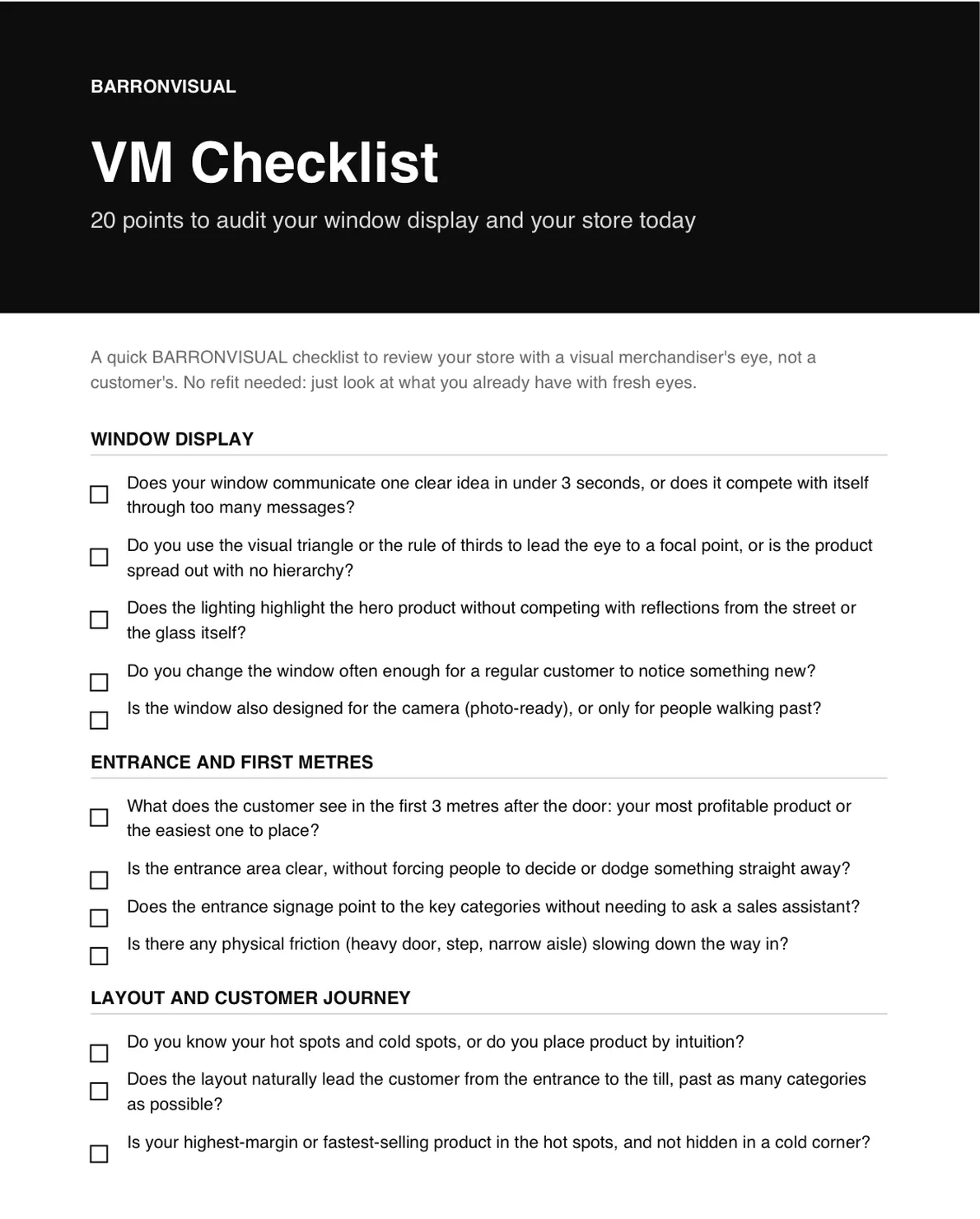
VM Checklist: 20 points to audit your storefront and your store today.
A short PDF to review your store with a visual merchandiser's eye, not a customer's. No renovation needed, just look at what you already have with fresh eyes.
I send you the PDF and, over the following days, 4 short emails to apply it. Unsubscribe in one click.




 I don’t want to write a «bad brands» article. I want to do something more uncomfortable: analyze a system with many degrees of responsibility.