2. The sensory window display
A good window display isn’t only seen: it’s also designed for the other senses, even while the customer is still on the other side of the glass. Brand researcher Martin Lindstrom documented, in his book «Brand Sense», the largest study done up to that point on how the five senses affect brand perception, carried out together with Millward Brown across 13 countries. One of his most cited cases is Singapore Airlines, which patented its own scent («Stefan Floridian Waters») built into its flight attendants’ perfume and into the hot towels handed out before takeoff, extending its sensory identity beyond the visual. In physical retail, the most repeated example is Abercrombie & Fitch, which pumps its signature fragrance «Fierce» through all of its stores as a deliberate olfactory branding strategy. We cover this in Sensory Marketing and Window Display, with the real-world case of Sephora: The Empire of Sensory Visual Merchandising.

3. Window display with a cause, and with perspective
The shop window is also a space of representation: who appears in it, how they appear, and what story gets told, has real consequences for who feels welcome in a store. The most recent and best-documented case is Primark, which in July 2025 introduced «Sophie», its first wheelchair-using mannequin, after a design process of nearly a year with activist Sophie Morgan, reviewing body dimensions, 3D mock-ups and real wheelchair specifications; it’s now present in 22 flagship stores. The context that justifies the initiative speaks for itself: people with disabilities make up 16% of the world’s population and are barely represented in fashion marketing. It isn’t the sector’s first such gesture: Sainsbury’s already featured Natty Goleniowska, a 7-year-old girl with Down syndrome, in its 2014 back-to-school campaign, and River Island did the same in 2017 with 11-year-old Joseph Hale. A more radical precedent was The Phluid Project, which opened in March 2018 in New York’s SoHo as the world’s first completely gender-free store, with genderless mannequins wearing unisex pieces from Levi’s, Soulland and Gypsy Sport, among other brands. An academic study on diversity in visual merchandising actually found that mannequin size is the variable that most influences how customers perceive a store’s real commitment to inclusion, more than mannequin color or signage. On the artistic side, we trace the imprint of a key figure in conceptual window display in Goodbye, Yayoi Kusama.

4. From the window to the sales floor: the tactical transition
The window gets the customer to walk in. What happens in the first few steps inside the store decides whether that entry becomes a sale. That «transition zone» or «decompression zone» was first described by Paco Underhill in «Why We Buy: The Science of Shopping», a book translated into 27 languages and used in MBA and design programs, based on years of real video footage of shopping behavior. For a long time, his finding was read as «that zone is no-man’s-land, don’t put anything there.» A 2018 field study by researcher Tobias Otterbring (Aarhus University/Karlstad University), published in the International Journal of Retail & Distribution Management, on 715 real customers in a home goods store, qualified that reading: customers exposed to candles and candle holders right at the entrance bought significantly more of those specific products than those who didn’t see them, even with an employee greeting shoppers next to the display. The practical conclusion is the opposite of the popular interpretation: the entrance isn’t a dead zone, it’s a zone that must be designed with the same intent as any other. We explain this in The 5 Unwritten Rules of the Tactical Transition from the Street to the Till and in The Toxic Marriage of Selling: Window Display and Visual Merchandising.

5. Window display and local commerce
Window display isn’t the exclusive preserve of luxury. A neighbourhood shop with a well-thought-out window can compete on equal footing with chains that have far bigger budgets. We cover this in A Window Dresser in Spain: Visual Merchandising for Local Commerce.
The most studied attempt to revitalise local commerce is Britain’s Portas Review: commissioned by the coalition government in 2011, Mary Portas published, on 13 December of that year, 28 recommendations for saving the UK’s high streets. The government responded in March 2012 with the «Portas Pilots», £1.2 million shared among 12 towns chosen from 371 applications. The real outcome, measured five years later by the Local Data Company for the BBC, was a net loss of 969 shops across those 12 pilot towns, a 17% decline. Mary Portas herself has been candid about it in public statements: she described her own plan as «quite a big PR campaign, which felt like it was saying ‘hey, we’re doing something’, and it hoped it would kick-start something, but it didn’t.» Independent retailers in the pilot towns told Drapers magazine that the programme «had its own agenda» and that much of the funding went into websites or a «terrible food festival» rather than direct support for shops. It’s a useful precedent, with real strengths and shortcomings, for any local-commerce revival strategy being considered today. We trace Mary Portas’s own method in Mary Portas: the «Queen of Shops» Who Taught How to Save Local Commerce.

6. Real cases of narrative window display
Window display is best understood through concrete projects:
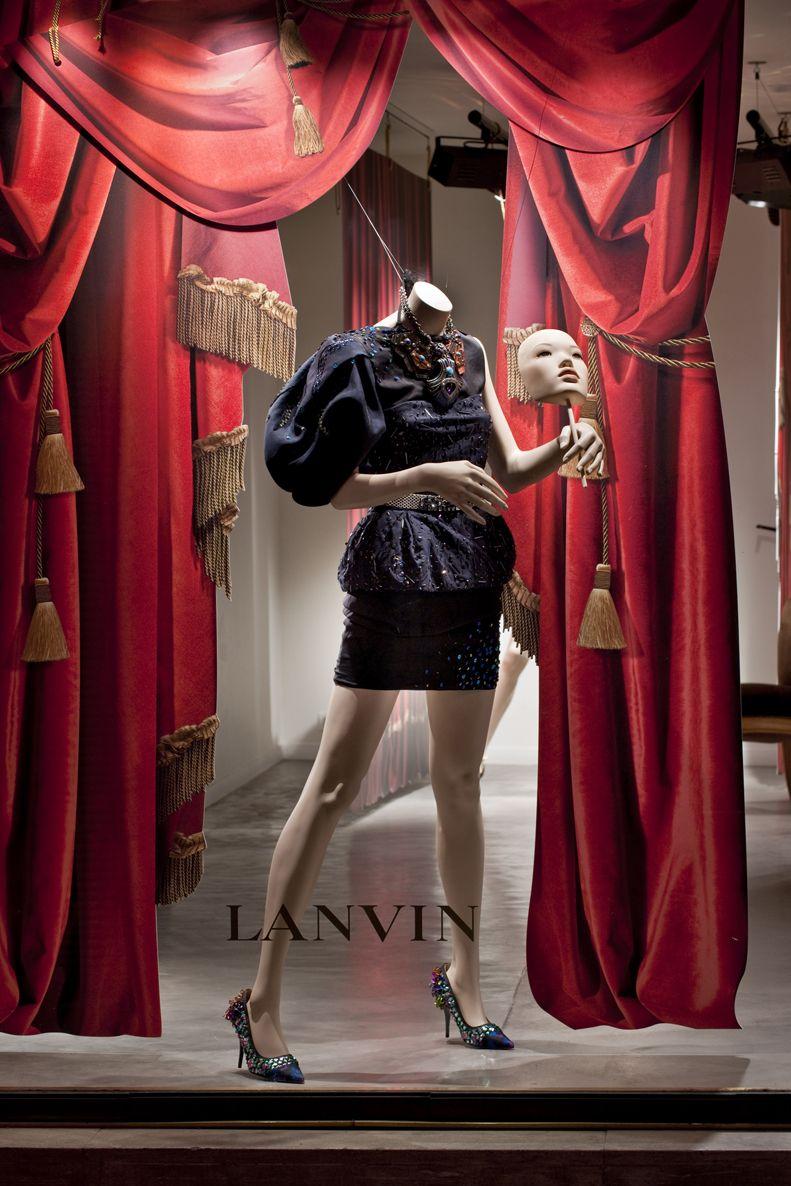
- Theatre on the Street: Lanvin, narrative window display in its purest form, at the flagship store on Paris’s Rue du Faubourg Saint-Honoré, where the brand has had a presence since 1889. Under the artistic direction of Alber Elbaz, a window display recreated a constellation of butterflies in flight, as a direct tribute to the house’s autumn/winter 2013 collection, which had brought the butterfly print to the runway.
- Nudie Jeans and Its Global Repair Station, a window display built on a genuine brand value: lifetime repairs. The programme launched in 2012 and now runs in 35 stores worldwide; in 2019 alone it carried out 63,281 repairs, and in 2022 it was around 65,000. Its own head of sustainability, Kevin Gelsi, sums it up plainly: «we trust in the added revenue over time, and in the long-term perspective.» The slogan, «free repairs forever», is also its most honest window display.
- The Crime on the Balance Sheet: How Inditex Sold Its Visual Soul, the craft’s own critical side. The hard data backs the criticism: according to the Swiss NGO Public Eye, transport accounts for around 20% of Zara’s clothing carbon footprint, well above its competitors, due to its reliance on air freight, and Inditex’s transport emissions rose 10% in 2024. In 2023, Zara produced 450 million garments, the equivalent of 620,000 tonnes of product, generating more than 7,000 tonnes of textile waste a year directly linked to overproduction; its «Join Life» sustainable-labelled collection accounts, according to its critics, for only around 20% of everything it manufactures.
A case we hadn’t yet covered on the blog, and one that deserves a mention of its own for its real influence on the craft, is Dover Street Market, the store Rei Kawakubo (Comme des Garçons) opened in London in 2004 under the concept of «beautiful chaos», deliberately inspired by the improvised disorder of Kensington Market. DSM practises «Tachiagari»: it closes for several days each season to redesign itself completely, with interventions from guest artists such as Ai Weiwei, Karl Lagerfeld or milliner Stephen Jones, who once hung hundreds of hats from the ceiling.

7. When window display becomes criticism
Not everything written about window display on this blog celebrates the craft. Sometimes the window itself is the best evidence of just how far a brand puts selling above every other consideration. Fast Company put it bluntly: the shop window functions as «a vehicle for consumerist, capitalist desires, rooted in 19th-century material innovations and in political, economic and consumer trends, designed to seduce and to sell.» The critique of window display as a machine of consumption has serious roots: Vance Packard sold more than a million copies of «The Hidden Persuaders» (1957), a direct attack on the «motivation research» that advertisers and retailers used to exploit consumers’ unconscious desires. Decades later, Harvard economist Juliet B. Schor, in «The Overspent American» (1998), argued that overspending isn’t explained by a lack of individual self-control, but by a culture in which spending has become «the definitive social art», an endless status competition. We lay this out without filters in The Dirty Secret: Are We Selling Products or Fuelling Consumerism?
What now? From a beautiful window to a window that sells
A memorable window display is only half the job: the other half is turning whoever looks at it into someone who walks in. If you want an honest diagnosis of your window display and your store’s real customer journey today, start with the Phygital Retail Audit, or take a look at the full Design Studio.