2. The Digital Transformation of the Storefront Window
For decades the storefront window was a purely physical exercise: glass, lighting, mannequin. Today it also competes with the digital storefront, the first screen the customer sees before deciding whether to walk through the door. We compare both worlds in Digital vs. Traditional Window Display and analyze a real case of this transition in The New Window Display: From Glass to Pixel, the Zara/Inditex Case Study.
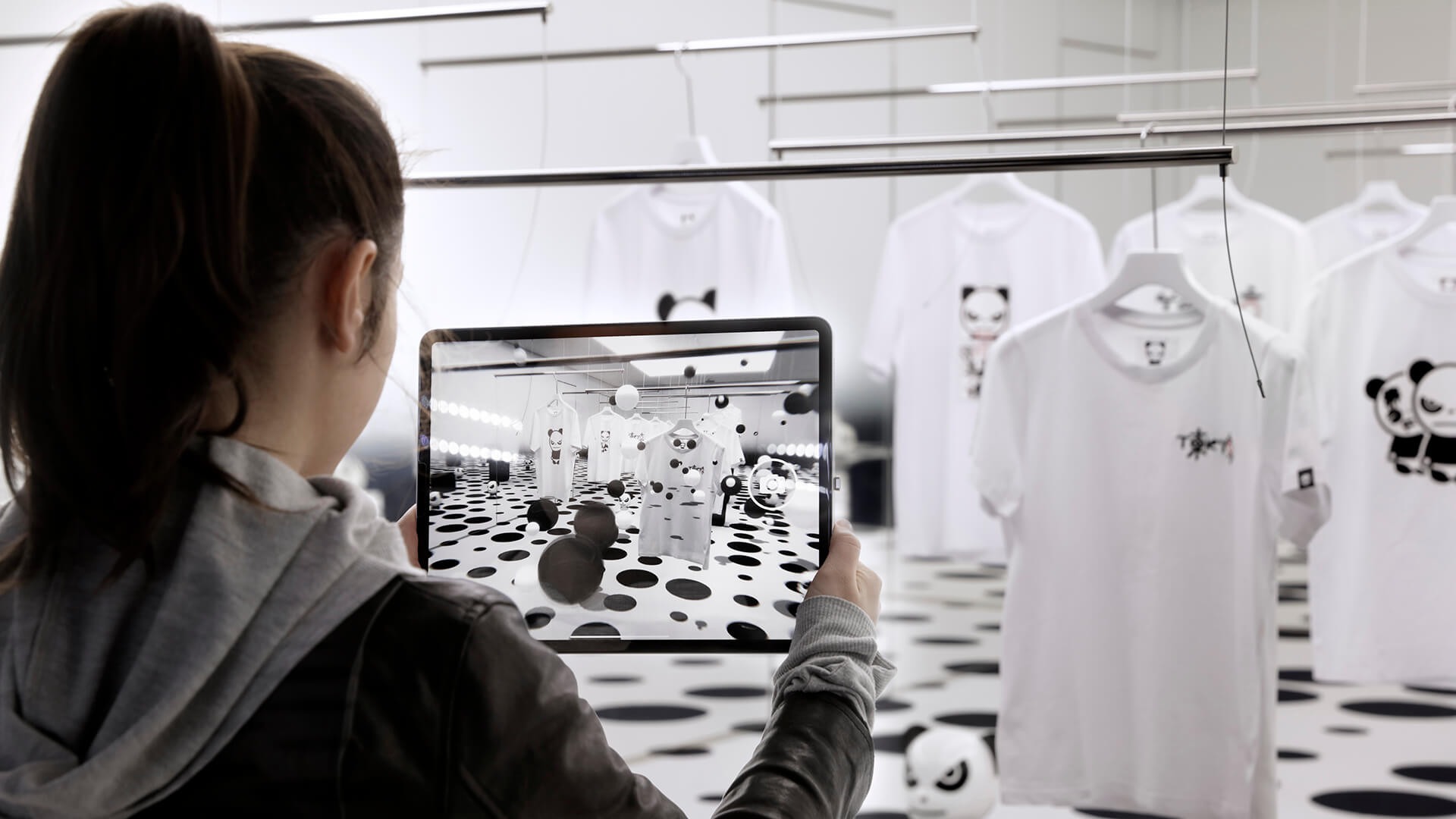
The most cited example of this transition is still the Zara AR app, launched on 18 April 2018 in 120 stores worldwide: during the campaign, the storefront windows were emptied completely, with no mannequins or clothing, and the customer had to point their phone at the glass to see models Léa Julian and Fran Summers «come to life» in 7-to-12-second sequences presenting the collection, with the option to buy directly from the app. It wasn’t the only serious attempt: Nike installed a series of motion-activated interactive windows at Selfridges (London), one of which invited passers-by to jump on a marked spot on the pavement to unlock content about a specific pair of trainers. And Burberry took the idea to its fullest expression at its Regent Street flagship (2012), named «Burberry World Live»: 44,000 square feet, screens up to 22.5 feet tall, 420 speakers built into the building’s protected architecture, and RFID-reading mirrors that, when a chipped garment was brought close, projected the exact moment of that piece on the runway. At its Shenzhen social store (2020), the brand went further: the entrance window itself responded to body movement to generate shareable social content on the spot.

3. From the Store to eCommerce (and Back Again)
The physical store has spent more than a century perfecting sales techniques that eCommerce is still learning to translate to a screen: cross-selling at the till, guided routes, social proof right at the point of sale. We explain this with concrete examples in Visual Merchandising 2.0: How to Bring the Store’s Magic to eCommerce.
The movement also works in reverse: chains like Home Depot, Walmart, Best Buy and Staples have had «endless aisle» kiosks in-store for years, letting customers order any item from the online catalogue even if it isn’t in that particular store, with delivery home or to another pickup point; Adidas added click-and-collect to its operations in October 2017 with the same objective. There is even real academic backing for the idea that the physical store generates the same «adjacent discovery» effect as an online recommendation algorithm: a study published in the Journal of Marketing (covered by the California Management Review, Berkeley) shows that customers who inspect a physical product in depth, touching it, trying it on, are more likely to later buy adjacent categories, both in-store and on that same brand’s website. The best documented case of this connection is Rebecca Minkoff’s connected fitting room: its CEO, Uri Minkoff, credited the technology with tripling expected in-store sales, and a Zivelo study confirmed a 50% higher average basket value among brands that adopted it (Rebecca Minkoff and Ralph Lauren, among them), with customers spending 40% less time in the fitting room and being 3 times more likely to buy. The system itself, using RFID tags, detected in one store that a leather jacket had been tried on 70 times in a week without selling, and that half of those customers had requested a different size from the touchscreen: the data revealed a real sizing problem that nobody had spotted at a glance.

4. Events and Activations That Connect Both Worlds
The in-store event is, when well designed, the most direct phygital piece there is: it generates a real reason to visit the point of sale and, at the same time, content for the digital channel. We develop this in In-Store Events: How to Turn a Moment into Real Sales. The strongest examples of this connection are not isolated one-off events, but exactly the same cases already cited in the digital storefront: Zara’s AR app turned every empty window into an event the customer had to activate with their phone; Burberry’s social store in Shenzhen turned the entrance into a content-generating moment; Nike’s interactive windows at Selfridges turned the simple act of walking past into a measurable activation. The underlying lesson is that the phygital event that works best isn’t the one added on top of the store, but the one that is born from the storefront window or the point of sale itself as part of the design, not as a marketing add-on.

5. Phygital Retail for Local Commerce
Phygital retail isn’t just for big chains. A neighbourhood shop or a small-town store today competes against the digital storefront of any brand in the world, and needs the same design criteria and online presence as a big-box retailer, adapted to its scale. We cover this in How to Revive a Provincial City Centre (and Your Store Along With It).
Real data from Spain shows a still-wide gap to close: according to the INE (Spain’s National Statistics Institute), 26.6% of Spanish companies sold online in 2024, generating €399.368 billion (+3.5% compared to 2023), with retail trade below the overall services average. The Spanish Chamber of Commerce is more specific about the sector itself: only 16.3% of retail companies consider themselves to have an advanced degree of digitalization, 53.3% remain at a medium level and 30.5% are still at a low level. Size matters a great deal: 58% of stores with fewer than 10 employees believe they have medium or advanced digitalization, a percentage that rises to 86% in companies with 10 to 49 employees and to 94% in those with more than 50. Even so, the sector itself acknowledges the push: 41.5% of retailers accelerated their digitalization since the start of the pandemic. There are real cases of Spanish local commerce already doing this: businesses like Vintage Closet, El Equipo de Viaje and Spicy Yuli have added an online store and automated customer service to sell outside their city, even to Portugal, without ceasing to be the neighbourhood store they always were.

6. When Phygital Retail Goes Wrong
Not every store digitalization adds value. Putting in technology without real visual merchandising criteria, or without connecting the data it generates to design decisions, is spending without a system. We analyze this bluntly in The Phygital Rebellion of Retail: Why Spanish Brands and Retailers Still Ignore VM Data and Are Losing Millions.
The most striking case of recent years is Amazon’s: in April 2024 it removed its «Just Walk Out» technology (checkout-free shopping via cameras and AI) from all its Amazon Fresh stores in the US, replacing it with smart carts. The real reason, as trade press revealed, is that despite being presented as «cashier-free,» the system relied on more than 1,000 people in India manually reviewing camera footage to validate each charge; the installation and maintenance cost turned out so high that the technology never even reached half of the existing Fresh stores. Amazon itself publicly acknowledged it had failed to achieve «a truly differentiated customer experience with the right business model for large-scale expansion». The final outcome came on 27 January 2026, when Amazon announced the complete closure of all its Amazon Go and Amazon Fresh stores to focus on Whole Foods: the world’s largest company’s biggest physical-retail technology bet, shut down entirely. A similar case, on a smaller scale, is b8ta, the «store as a service» chain that rented physical space to tech brands complete with customer behaviour analytics: it closed all its US stores on 18 February 2022, after having exceeded 20 stores before the pandemic and closing 15 in 2021 alone, weighed down by falling mall foot traffic and by security costs that at its Hayes Valley store (San Francisco) exceeded $30,000 a month after a robbery. Technology wasn’t the problem in either case: the problem was building the economic and operational model around the technology instead of the other way around.

What now? From concept to the system that connects the store and the digital channel
This guide is one of three. If the physical space is your priority right now, continue with Retail Design: The Complete Guide. If what you’re looking for is the sales and experience criteria itself, continue with Visual Merchandising: The Complete Guide.
Understanding phygital retail as a concept is the first step. Applying it as a system, with data and a design criteria that stays consistent across channels, is what changes real results. If you want an honest diagnosis of where your store or your brand stands today, start with the Phygital Retail Audit, or review the complete BARRONSYSTEM System.